Showing posts with label Hostel. Show all posts

Sunday, April 6, 2014

Australia: Whitsunday Islands in a Weekend

Trip Date: 06-08 September 2013


A few months ago, back in early September, I took off early and flew from Sydney to Hamilton Island, one of the entry airports to the Whitsunday Islands on the central Queensland Coast. I’d heard about the Whitsundays from a couple of friends who’d been there before and the more I looked into it, the more these pristine islands, world-famous for their sailing cruises, appealed to me.

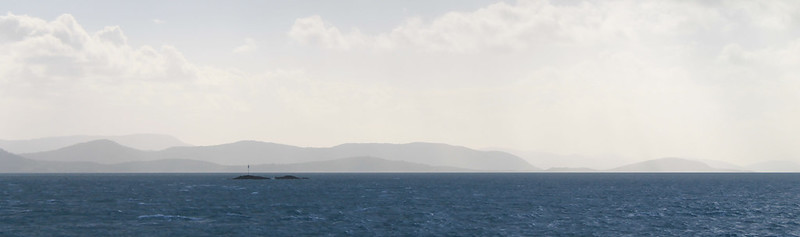
Whitsunday Islands
The beautifully hazy Whitsunday Islands

If you’re traveling on a budget and have the time, you might consider flying in to Mackay a few hours to the south. But if you sign up for discount airlines’ emails, you can get affordable tickets right into either Proserpine airport at Airlie Beach (on the mainland) or into Hamilton Island airport on, well, Hamilton Island. When I booked my tickets Hamilton Island was my best entry point and it was still cheaper and more convenient to buy a round-trip ferry ticket to Airlie Beach on the mainland than it is to fly into Mackay and find your way up to Airlie Beach. Alternatively, if you have a good couple of hundred of dollars in your pocket, which I as a student do not, you can just stay out on Hamilton Island in one of their very swanky accommodations.

I got in on a Friday afternoon while the flight was smooth most of the way up, the winds coming in off the Pacific made for a very bumpy and tipsy landing – one of the worst I’ve experienced in a while! With that said, the views coming in to Hamilton Island are stunning. Beautiful blue water, dozens of lush green islands, and stunningly white sandy beaches. It makes landing on a short island runway all worth it!

The weather wasn’t all that great and I began preparing myself for a less-than-relaxing sunny beach weekend than I expected. While waiting for the ferry to take us to the mainland, the clouds came in dark and ominous and at times spitted a bit of rain. Back in February of 2013, a massive storm struck the islands causing widespread damage that was still visible in September as some boats were still washed up onto breakwaters, shoals, and jetties – but of course none of the tourism ads show that but rather want you to think it is always sunny here (something the girls in the row in front of me on the plane clearly had in mind). It all just depends on what you get and you should just prepare yourself to have fun no matter what.

And that was my plan. I’d booked a bed at the YHA in Airlie Beach and planned on doing some beach-visiting, snorkeling, and bushwalking while I was here over the next day and a half. Like all other YHA hostels I’ve stayed at, the one in Airlie was fine for accommodation, though maybe a bit more utilitarian. It was quiet when you wanted it to be and comfortable, though, so I had no problems with it. It is a backpackers’ accommodation though, and one thing you can’t get away from is the constant pressure to socialise with anyone else who happens to be staying in your room. I’d booked a bed in a dorm and there was a nice guy from Sweden in there who immediately started chatting me up. I was fine with that for a few minutes, but the incessant need for him to keep asking me questions about where I was from, why I was in Airlie Beach, and what I was going to do there started driving me crazy. After a series of me giving him one word responses, I decided I needed a sign that reads, “The only reason I’m staying here is because it’s cheap,” especially if I keep staying at hostels rather than the more expensive beach-side resorts.

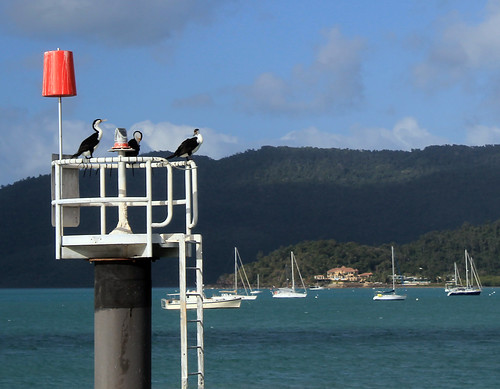
Cormorant Welcome
The cormorant welcoming committee in Airlie Beach
I really wasn’t trying to be antisocial, but I had already decided on the flight in that this was going to be a nice me-weekend. Unfortunately, Airlie Beach is just not a place for that as backpackers are literally everywhere and the atmosphere in nearly all of the local pubs and bars plays testament to the party scene Airlie is so well known for.

I decided on a pub for a burger desert – it doesn’t really matter which pub; they’re all crap and went back to the hostel to test out my new LifeProof waterproof iPhone case. Initially, I’d wanted to invest in a GoPro camera for all of the snorkeling I was going to be doing over the next few months, but they’re not cheap and instead I decided an iPhone case was the next best thing. Customer reviews did nothing but rave about LifeProof cases and for $70, I figured I’d take the risk and after unpackaging the case in the hostel and submerging it in a rubbish bin full of water (without the phone in it, of course) for half an hour, the inside proved to be perfectly dry. I was happy with it enough to give it a go out on the reefs.

Early the next morning, me and a few other backpackers (I hate using that term for myself, but it’s just easier) were picked up from the YHA by Ocean Rafting, a company I found through Trip Advisor which is eco-certified and boasts their pro-environmentalism vehemently on their website. Considering the Earth is continuously warming and ocean acidification an ever increasing problem, I figured it would be responsible of me to go out to the islands and reefs with a company that so clearly cares about the environment they take tourists to. Ocean Rafting also was appealing because their boats only take ~25 people on them so you get a much more personalised and intimate tour of the Whitsundays. Finally, Ocean Rafting has a sister company in Cape Tribulation (Ocean Safari) and you can get a small discount if you book a combo trip with both companies and since I’d be going up to Cape Tribulation in October when my family visited, I figured I might as well save a few bucks!

We were some of the first ones out to the dock where our boat, Thunderstruck, was moored and it took a while for everyone else on our tour to show up, but soon we were all squeezed into our wetsuits – a new experience for me – and stepping on to Thunderstruck which was an open-topped speedboat with large pontoons on either side. We could either sit on the benches or on the pontoons and our van-driver that morning said today was a perfect day to ride up front or on the pontoons since the swell coming in off the ocean was still pretty big and the boat was designed for wavy conditions. I had no intention of missing out on any bit of adventure, so I rocked on up to the front row of benches with a truly Irish couple – the guy had a penchant for saying, “Fuck” and “Shit” every other word – which got to be a bit much by the end of the day, but they were good company.

The sun was not out in full brightness yet, but I could tell that the rough weather experienced on my arrival the night before was clearing up and by the time we picked another few people up from Daydream Island and passed through the Molle Islands, the clouds had disappeared and it was obviously going to be a great day! There are dozens of islands in the Whitsundays and when big ocean swells hit them, the waves are refracted around the islands, funneled between narrow passages, and come at you from every which way, which made our boat ride out to the channel between Hook and Whitsunday Islands incredibly bouncy and fun! People were screaming as the prow of the boat lifted up over a wave and came crashing down into the trough on the other side. Our morning driver was right – the choppier the water, the better the ride is on these boats!

We passed through the narrow channel between Hook and Whitsunday Islands and turned right to follow the shoreline of Whitsunday Island which rose up from the sea in steep, bare granite cliffs. It wasn’t before long and the boat slowed down on the opposite side of a skinny peninsula that separated us from the famous Whitehaven Inlet and beach. We hiked up to the ridgeline of this skinny peninsula barefoot and in our wetsuits through the subtropical heat and humidity to a vantage point from which you can see Whitehaven Beach in all of its pristine, white, sandy glory!

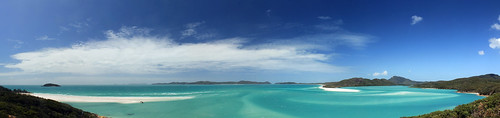
Whitsunday Islands National Park
Beautiful turquoise waters and white sand of Whitehaven Beach and Whitsunday Inlet.

To the local Aboriginal people, the Whitsunday Islands are sacred and focus heavily in their Dreamtime stories and of particular significance are the literally thousands of stingrays that call the estuary home. The estuary itself is not terribly long but it is quite wide and the stream flowing out to the ocean is clearly marked from the white sandy deposits by its bold, brilliant, turquoise colour. From the viewing platform, you see not only the stunning estuary, but you look down over bright white sand spits built by longshore currents transporting sand down from Whitehaven beach which stretches as far as you can see in front of you. Geologically, the sand on Whitehaven Beach has been transported hundreds of kilometers along the Australian coast and the purest quartz sand grains are eventually deposited along the beach as coastal currents eddy between the Islands. The fine silica sand is so pure that even on the hottest days it is quite cool to the touch because quartz just does not retain heat well. It is easy to see why the Whitsunday Islands are designated a UNESCO World Heritage Site.

We didn’t linger long at the viewing platform, abandoning it for lunch down on the white sand spit at the mouth of the estuary. The great thing about the tour with Ocean Rafting is that they are the only company allowed to anchor in the estuary itself. No other company is allowed to anchor here and no one is allowed to remove anything from the beach or any of the islands due in part to their listing as a World Heritage site, but also due to their sacred significance to the local Aboriginal people. Only one organization has legally been allowed to remove sand from the beach. Back when NASA was building the Hubble Telescope, they needed the purest silica in the world to melt and form the telescope’s lenses, as any impurity at all would ruin the telescope’s capabilities of photographing space’s wonders.

We spent about an hour on the white sand spit trying to keep our lunches from being stolen by seagulls. No one really talked and while I think it was because of the sun and hunger, I’d like to believe it was because everyone was in awe at this magnificent gem of natural beauty!
After lunch, our boat took us back north toward Hook Island and through what the captain and tour guide referred to as the Devil’s Washing Machine – an area of water where the swirling eddies converge together and the ocean’s wave double in height! Sitting on the side pontoon of the boat, with nothing to hold on to but a small canvas strap between my legs, this proved to be much bouncier of a ride than if I’d had a seat in the boat but it was amazingly fun feeling your body leave your seat as the boat falls back to the water after running off the crest of a wave!

Soon we arrived at the first of our two snorkeling sites on the east side of Hook Island. This was the first time I was going to have willingly jumped into the ocean since I went snorkeling in New Zealand’s Bay of Islands, which was the beginning of conquering my personal and very irrational fear of the ocean! I knew that putting myself in with a group of people who weren’t afraid to just jump in the ocean would pressure me into not being a chicken, but then while the captain was explaining what we’d be seeing at this site, his deckhand pulled a jar of fish food out and started throwing the little kernels of food into the water. As he did this schools of fish too many to count would swarm the water where the food landed – mostly schools of a blue-yellow fish (NOT SURE WHAT IT’S CALLED??).  But what worried me the most was the much larger Maori wrasse – massive fish that can grow to six feet in length with large beak-like mouths. Supposedly, Maori wrasse are harmless, but their size was intimidating enough for me to hold back on the boat much longer than everyone else, petrified to jump in in case one of these massive fish were to sneak up on me!

But money talks, and I reminded myself that I’d bought the waterproof iPhone case for this purpose and that I needed to put it to good use. I slipped on my flippers, tucked my camera into the sleeve of my wetsuit, donned my mask and snorkel and flopped off the side of the boat. I was in, and it was amazing! Whereas we saw heaps of sea urchins and seaweed amongst the rocks snorkeling in New Zealand, there was nothing but fish and coral here! Huge stacks of all of the coral you’ve seen in movies, books, and pictures and just as many types I’d never seen or heard of before! There were loads of fish – mostly the ones schooling around the food but also rainbow parrotfish, big fish, small fish, and yes, even the great Maori wrasse which I saw sneaking up on me from behind, though turned away before getting too close to me!

We were in the water for about an hour before being called back to the boat, which didn’t take me long as I didn’t dare venture too far away, but took some of the more intrepid explorers a wee bit longer. Because of the windy weather that hit the islands on the previous few days, sand had been stirred up all around the islands that made visibility low and the captain thought we might have better luck a few bays further around the island. We made the short trip to the next bay and spent another hour or so exploring the corals here. Indeed visibility was better and I was a bit more adventurous and tried seeing as much of the reef as I could. It was truly like being in an underwater wonder world and even I was amazed at how quickly my inhibitions melted away under the spell of the reef.

Hook Island Reef
Parrotfish on the reef!
I think everyone should be able to experience a tropical reef up close at some point in their life  - though the scientist in me cautions anyone who does to be very conscious about what company they use to get to the reefs. Climate change, warming ocean waters, and acidifying oceans are killing reefs all around the world. They are some of the most delicate and fragile ecosystems in the world yet are crucial for the survival and sustenance of all the oceans.

It was getting late and we boarded the boat one last time before finishing our circumnavigation of Hook Island, past the old resort of Hayman Island, and back toward Airlie Beach. The seas were still rough but I wasn’t upset I once more found myself riding the pontoon on the way back for one of the wettest rides on the boat!

There’s nothing to report from my second night in Airlie Beach because it’s a dive and not worth wasting words on.

I woke up early on my third day in the Whitsundays and walked back to the ferry docks to catch the first ferry back to Hamilton Island. My flight back to Sydney wasn’t until later in the afternoon, but I wanted to do a bit of bushwalking and it looked like there were some great trails on Hamilton Island. Indeed, once you get past all of the resort villas, bungalows, hotels, condos, and conference centres, you find a track that leads up to the rocky lookout called, Passage Peak.

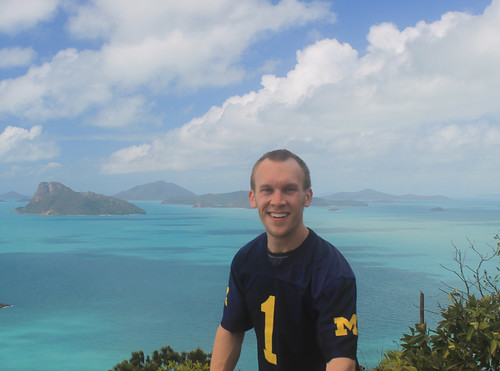
It only took about an hour to reach the peak, though unless you’re an avid hiker, I’d plan on it taking more than that. The weather was hot, but the sky was perfectly clear for looking out over the islands from one of the highest points in the islands! Fluffy white clouds marched through the sky in endless precession, casting shadows on the clear turquoise water. I had a nice chat with some other bushwalkers at the top and they pointed out some pairs of whales they’d seen while I told them about Whitehaven Beach which you could see over the lush green slopes of neighboring Whitsunday Island. Though it was Sunday in Australia, it was a Michigan Game-Day Saturday back home, and in true fashion, I proudly wore my UM Jersey, which I also had to explain to the other hikers, but they generously took photos of me, saving me from yet more selfies. Eventually they left and thus left me to one of the most spectacular viewing points of natural beauty I’ve ever seen!

Wherever You Go, Go Blue!
Going Blue during a bushwalk to the summit of Passage Peak on
Hamilton Island. I believe we beat Indiana that day!
I had plenty of time to walk back to the airport, so I took my time with it singing Michigan Songs from Glee Club on the way down since I think it was the weekend we beat Indiana. I called and chatted to my sister over lunch and then made my way to the airport which is conveniently within walking distance from the marina and after not too long was back in the air headed home to Sydney. 

My weekend in the Whitsunday Islands reaffirmed what I’ve learned so often in Australia: it does not take much time or money to have amazing experiences in beautiful locations. I was away for less than three days, yet I have some of the most vivid memories of nature, landscapes, the ocean, and animals I’ve ever had. If you get the chance, go! To the Whitsundays, absolutely, but also to anywhere you’ve been wanting to see!
 

Sunday, September 29, 2013

Australia: Alice Springs

Travel Date: 17 August 2013

Note: I am well beyond an outsider in Australia and there is a lot to learn about the Aboriginal cultures and ways of life. It is and can be a very sensitive topic in many Australian communities and if my wording or interpretation of what I learned is incorrect or offensive, please let me know. I am trying to be as truthful and as historically and culturally accurate as possible. Thanks!

Over the last few months, I've been watching the airline sales in Australia like a hawk. I was about halfway through my time in Australia for my PhD and was feeling a bit of a mid-Aussie-crisis and realised I might not get to see everything I wanted to if I didn't hurry. I'd planned to visit Australia's Red Centre in the southern Northern Territories in January when I have a bit more time, but then it dawned on me that the weather in the outback in January can be brutally hot! Then, a sale came in from Tiger Airways, from Sydney to Alice Springs and I just decided to book it. Now that I'm sitting in the airport waiting to head back home to Sydney, it was well worth the time off.

DAY 1 (3)
Alice Springs from ANZAC Hill and the western MacDonnell Ranges
Alice Springs is not a large town by Australian standards, though it is no tiny burb either. Because of its relative proximity to some of the outback's most famous sites, notably Uluru (the largest rock in the world), Kata Tjuta (aka The Olgas), and Kings Canyon, Alice receives a lot of tourism traffic by air as Aussies and backpackers alike flock here from all over the coastal towns and cities. Alice Springs has a more important place in modern Australian history, however, as being a telegraph relay station between Darwin on the northern coast of the Northern Territories and Adelaide on the southern shores of South Australia. The town even gets is Aussie name from a small pool of water seen near the Telegraph Station a few kilometres north of the present city, a rarity in the dry centre. In fact the pool of water was a temporary puddle, really - a result of previous rains which flooded the Todd River (which is otherwise a dry riverbed). For a short period of time in Australian history, there was a 9th territory - Central Australia - of which Alice Springs was its capital city. Eventually Central Australia merged with the Northern Territories and ceased to exist, but that didn't stop Alice Springs from remaining an important town in the otherwise desolate Ausralian Outback.

To the local Arrernte communities the land around Alice Springs was created by ancestral beings that created the landscape. Specifically, the MacDonnell Ranges were formed by three caterpillars moving across the country, digging their way through the land as they passed Alice Springs. Red river gums, found growing in the dry Todd River bed are sacred and believed to be ancient ancestor caterpillars as well. Another story involves a fight between an ancestral dingo and an anonymous adversary who both fought over a woman and in the midst of their fights created parts of the surrounding mountains including Mt. Gillen, a prominent point on the nearest mountain. The Aboriginal Australians have a deep connection with their surroundings because these ancestral beings formed every part of the landscape as they moved around and so these creation stories, or Dreamtime stories, form the foundation for all rules of social, political, and religious life in Aboriginal communities.

When I arrived in Alice Springs Saturday mid-day, I wasn't expecting much to be going on and thought I'd spend some time at the Natural History Museum, a few kilometres west of the town centre. After chatting to the receptionist at the YHA Hostel (a very nice hostel and in a great location) suggested a few other ideas and I settled on walking out of the city to the north where the original Telegraph Station was located. It was a beautiful walk through rocky sandstone and granite outcrops, red river gums, desert oaks, and beautiful wildflowers along the dry and dusty riverbed of the Todd River. The sun was roasting at midday but I finally reached the Telegraph Station after about an hour of walking only to find that there was a $9 fee to get in to the historic site. The very friendly lady (please note copious amounts of sarcasm here) working the small shop scoffed when I asked if there were student discounts and when I asked if there was anything to see without paying, she just pointed to the exit. So I walked around the fence enclosing the historic compound and then up a hill on which one of the Australian trig points, used as reference points for geographic mapping, was located and snapped a few photos of the MacDonnell Ranges to the west.

DAY 1 (34)
The US military personnel from nearby Pine Gap racing the ANZAC
servicemen in the hotly contested annual competition. The US
regained the winning title after last year's loss

Heading back into town along the River Walk I was in for a surprise. Contrary to my Lonely Planet Australia Guide (whose Alice Springs information urgently needs to be completely revamped!), one of the small city's most well-known and exciting events was happening on my arrival day: the Henley-on-Todd Regatta. Even though there is rarely any water flowing along the Todd River through Alice Springs, it is the site of one of Australia's most famous sailing races. Instead of actually sailing on water, the boats used in this regatta are just metal framed, canvas-wrapped "boats" that are picked up by the sailors and run along the race course on the dry river bed and back to the starting point. Hosted by the Mayor of Alice Springs and a number of other emcees, the boats are sponsored by local businesses and anyone in town, or from anywhere in Australia (or the world), can compete in various events including kayak, mini-yacht, and big-yacht races, hampster wheel relays, and tug-o-war for various age groups.

One of the main highlights of the event is a big-yacht race between the Australians and the Americans (military personnel from a nearby station). Apparently last year the Australians were the victors, but the Americans, racing in the USS Mayflower, prevailed this year and were quickly riddled by tongue-in-cheeck humour from the emcees but to great applause from the crowd who are just there for a good time. (The Americans also won the tug-o-war competition, as well, I might add!)
DAY 1 (40)
The Navy (left), The Vikings (centre), and The Pirates (right)
But the day's events culminate in the largest gunship battle to occur on Australian soil every year. Right at 4:30 three "ships" built onto the back of large trucks representing the Vikings, the Navy, and the Pirates enter the arena and drive around battling each other. The ships launch water balloons, fire coloured saw-dust canons, and hose each other down with high-pressure water guns all while trying to evade attacks from the other ships as the crowd cheers them on. Even though the Vikings were the first to run out of water and most-bullied by the Navy and Pirates, they seemed to be a long-time crowd favourite though it was the Pirates who came away victorious this year. The poor Navy lost despite their high-energy attacks and subsequently endured a host of adult-humoured, Village People, seamen-themed jokes from the announcers.

Interestingly enough, the Henley-on-Todd is probably the only regatta in the world to be cancelled due to wet weather as the usually dry riverbed surges with flash-flood waters flowing through the city (and this has happened at least once!).

After the Henley-on-Todd finished, I made my way up Alice Springs ANZAC hill where their memorial honouring fallen, former, and current armed service men and women dominates the town's skyline for a beautiful sunset over the western MacDonnell Ranges. It was my first taste for an outback sundown and what a sunset it was! The ever-present dust in the air in central Australia makes for beautiful red and blue sunsets and the silhouettes of the denuded mountains to the west made for a spectacular end to a great day.

Once the sun went down I found some quick take-away and went to bed since I was getting picked up the next morning for my 3-day outback tour.

Friday, July 5, 2013

Australia: Tasmania - Freycinet National Park

Trip Date: 26 April 2013

After a quick night in Hobart, my friend, Danielle, and I piled our things into her car and started our drive up the east coast of Tasmania. Our destination was Wineglass Bay in Freycinet National Park. When I first moved into my current apartment, my flatmate strongly suggested (no, he told me it was a must) that I go to Freycinet National Park because Wineglass Bay was so stunning it was just not to be missed!

Bicheno Waterfront
Fishing boats in Bicheno Harbour, Tasmania
Well, it took us a few hours to even get close, but we stopped a few times on the west side of Great Oyster Bay (west of the Freycinet Peninsula) for some photo ops and then drove past the Freycinet turn-off, continuing on up to the small seaside town of Bicheno. Not much ever seemed to be going on in Bicheno, but it sure looked like the perfect place for a vacation home. It still boasts a small fishing industry and some of the fishing boats were anchored offshore.

We stretched our legs along the waterfront for a few minutes and I was fascinated by the granite rock exposures along the beach - mostly because they had HUGE orthoclase feldspar mineral crystals - some as big as my finger! The tidal pools between the rocks were filled with little red sea anemones that twisted in the water as the waves came in and out. Bright orange lichens grew on the rocks, though we'd see more impressive lichens later on. We had a bit of fun posing in the dinghies pulled up on the harbour docks but soon headed back to the town and enjoyed a really good little lunch at a pizza cafe called, Pasini's.

Back in the car we drove south and headed down the access road to the small town of Coles Bay and the entry to Freycinet National Park. While many of Australia's national parks are essentially small tracts of land set aside solely for recreation without many stunning or staggering landscapes or ecosystems, Freycinet is different. Like the Blue Mountains, Royal, Uluru, Daintree, and Kakadu National Parks, Freycinet offers a spectacular mountain landscape with a few tall granite peaks with sparse vegetation growing up the slopes. As we turned the corner and the first view of Mt. Amos and Mayson loomed into view, my jaw hit the floor! I could already tell why my flatmate told me this was a park not to be missed!

Freycinet Panorama
Freycinet National Park seen from Coles Bay, Tasmania
We checked in to our hostel (the YHA in Coles Bay - which has impressively thin walls with two very loud groups of backpackers partying late through the night - avoid at all costs) and drove to the car park at the base of the trail to Wineglass Bay. It was late in the afternoon and we had limited time before the sun set, so we had to hurry a bit!

Wineglass Bay Lookout
My friend Danielle and me at the Wineglass Bay Lookout in
Freycinet National Park, Tasmania
The trail is well-traveled up to the Wineglass Bay lookout and winds its way through large granite boulders and banksia and gum bush. We stopped at the lookout and had amazing views of Wineglass Bay which is an inlet coming in off of the Southern Ocean ending in an impressively wide beach and some of the bluest of blue waters I've ever seen!

Not wanting to miss out on anything Danielle and I continued down the trail to the beach and were greeted by a solitary Bennett's wallaby who was saying hello to any of the beach's visitors, probably looking for food. He was definitely not skittish around people and while wallabies may be antisocial toward other wallabies, this little guy was certainly friendly toward me! I was able to get close enough that we had a little chat and I even took a selfie with my iPhone camera, much to Danielle's entertainment. Soon, the wallaby realised that my camera was not food and immediately became disinterested and hopped off to other hikers.

Wallaby Portrait
Portrait of a Bennett's Wallaby on the beach at Wineglass Bay in
Freycinet National Park, Tasmania
Danielle sat on the beach while I explored the coarse-sandy shores. A fishing boat was anchored not far offshore but was soon greeted by what we think was a police boat, likely wondering what a fishing boat was doing in protected National Park waters.

The rocks along the bay here were covered with the brilliantly-orange lichens we saw in Bicheno, and maybe it was the setting sun, but they seemed to be much more vivid in colour here! The sun was going down and we started back toward the car before it got too dark, and with perfect timing too, because as we neared the lookout the setting sun illuminated the clouds and rocks, almost setting them on fire! It was one of the most amazing sunsets I've ever seen, even by Australian standards! I can't tell if I've just become really good at taking photos of sunsets, or if Australia's sunsets are just always stunning, but it was just beautiful and I think my photos turned out quite nicely.

Sky on Fire
Sunset over Great Oyster Bay from Freycinet National Park (Yep, was really this red!)
Before heading back into Coles Bay we took a little drive up to Cape Tourville Lighthouse. It was now almost pitch black out and the moon was beginning to rise. The lighthouse is positioned on top of large bluffs overlooking the Southern Ocean and the winds started to pick up, making our walk around the lighthouse pretty chilly! I set up my camera a few times to try and get good nighttime photos of the lighthouse and coast, but without a tripod it was hard to keep the camera still while the shutter remained open long enough to get a decent exposure. The photos turned out pretty clear considering Danielle and I couldn't see each other even though we were only a few metres apart!

It was a perfect way to end a perfect day along Tasmania's east coast and we headed back into town for a dinner and drink at the pub before barely getting any sleep at the hostel. Yeah, while I recommend staying in Coles Bay, you're better off camping than trying to get any sleep at the hostel. But having such an amazing experience with the sunset and the wallaby easily made up for it!

Sunday, May 5, 2013

New Zealand: Bay of Islands

Travel Date: 04-05 January 2013

My last post from my trip to New Zealand over New Year's this year picks back up on the same day I visited the Waitangi Treaty Grounds near Paihia. Back in Paihia, however, I was about to embark on one of the coolest experiences of my travels. Traveling alone is not always the most fun, I don't think. As much fun as it is to meet new people and fellow travelers, it often feels like a broken record because you're always telling people the same things: where you're from, what you do, where you've traveled, what you've done on those travels - and then it starts all over. I'd much rather have someone to travel with, either friends or family, to be able to have an ever-continuing travel narrative that carries through the rest of the journeys. With that in mind, I booked myself a room in a YHA. But this was no ordinary YHA because Paihia is the gateway to the Bay of Islands which is no ordinary travel destination!

The Bay of Islands is a fantastic region on North Island, New Zealand and as its name suggests it is a bay - a picturesque beautiful bay - with islands in it - hundred of islands!! I'd been seeing travel posters for New Zealand advertising the Bay of Islands (BoI from now on) and the posters of course make the green islands stand out starkly from the crystal clear turquoise waters of the bay and the cobalt blue skies and little white yachts and tiny yellow kayaks appear to be floating on air. Obviously this photo was used to make it seem like the idyllic place to holiday, but could the BoI really be this perfect? I found out that the answer was and emphatic, "YES!"

The Rock
The Rock houseboat/hostel I stayed on while touring the Bay of Islands
on New Zealand's North Island
I said the YHA I booked was no ordinary hostel and that is because this YHA is in fact a car-ferry turned houseboat capable of hosting 36 passenters. Rock, The Boat was an ideal way to spend 24 hours on the water - and as the New Zealand Lonely Planet guide says, you can't truly see the BoI unless you're on the bay! The way I justified was this: if I'd booked a hostel, eaten out or even cooked my own food, rented a kayak for a few hours, chartered a fishing guide, and booked a snorkeling outing, I would have spent well over NZ$300! By booking a room on The Rock I could get all of this for a measly NZ$188! Sometimes I think touristy packages like this are overhyped, but I decided to go for it and I was not disappointed in the least bit!

I parked my car at the Paihia YHA (for the land-lubber backpackers) - for free, which they let me do since I'd be spending my money with YHA anyway - and headed down to the dock where I waited in line with a hoard of girls speaking German, a couple of couples, and one chatty South Korean girl from Auckland who was taking the weekend off. No one was really interacting with anyone outside their group, which didn't really bother me; I figured if people weren't social on the boat at least I'd get some relaxation. We were shortly greeted by two guys in their mid-20s who introduced themselves as part of the crew. They put our bags in a boat, gave us some life-jackets and brought us out to a two-level brown houseboat in the harbour. Being an old car-ferry, the boat's back was the former ramp and was kept in the down position as a kind of landing-deck. There was a rack of kayaks on the back and a spiral stairway up to the back deck on the second floor with a New Zealand flag attached. The inside of the boat was amazingly cozy! On the back was a small ring of benches surrounding a wood-burning stove. A large bar occupied the middle of the boat and was where drinks were served and the crew cooked the meals. Bathrooms were small and off to the side and the rest of the main floor was lined by various seats and tables. There was a piano, a foosball table, racks of magazines, and the open rafters were decorated with various antique nautical instruments, tackles, lures, fish, bottles, and so on! The upstairs was where all the rooms were. The four crew members had their rooms up near the front of the boat and the guest rooms took up the rest of the space and were either double rooms, or bunk rooms with six-beds each. The boat could host 36 passengers at once, but luckily there were only 13 of us so it was much more relaxed and much less crowded!

As our captain started bringing us out to the centre of the bay, the crew started the daunting task of making sure everyone knew everyone else and felt part of the family! To get things started they had a wooden duck on a small raft tied to the houseboat with a piece of string. Each of us were then to take turns, introduce ourself, say one unique thing about us, and then take a turn shooting at the duck with a paintball gun! Whichever guy and girl shot the duck first received a free drink from the bar. So it was pretty quickly that we all met each other, started sharing stories, and realised how bad of shots we were with a paintball gun! The crew was amazing at their jobs. I can't imagine the cruise being as fun as it was if the crew had just let us do our own things, but they encouraged us to socialise and though we didn't really get to know each other that much better by the end than we were at the beginning, that first activity broke down those initial barriers and at least got us talking to each other and having a laugh.

Bay of Islands
The Purerua Peninsula making the northern boundary of the Bay of Islands
The weather was perfect and the water nearly perfectly flat on the bay, just like in the photos! The distant hills were beautifully green and the water sparkling blue. We all socialised a bit on the boat watching other watercraft lazily wander around the bay until we got to our resting spot for the night, a small bay off of one of the mainland peninsulas which twist their way into the BoI. We dropped anchor and were told we would be fishing for our dinner. One of the crew cut up a fish for bait and gave each of us some fishing rods and we all stood off the back, or on the adjoining small boat and tried our luck. I wasn't lucky at all, but one of the guys caught two or three red snappers which we were able to keep and another crew member started to prepare it for dinner. After a few drinks and more chatting while waiting for the rest of dinner to be prepared we had one of the best meals I've had on a boat: steaks, fish, salads, potatoes, and beer. Delicious!

It started to rain a little bit, but the few clouds quickly passed and then the stars came out. There was no moon, so it was especially dark, and I couldn't believe the number of stars I could see! With the sun down and the stars out, our next activity began. We split into two groups and were going to do some nighttime kayaking around the bay which was special because at night, especially on clear nights, you could see bioluminescent algae phosphoresce and light up as you disturbed them by paddling through the water. In the eddies of water spinning around the kayak paddles little specks of light would twinkle and flash and then die out as water returned to a calm normal. If your eyes were keen, you could also see fish swimming around beneath your kayak by the traces of light left behind in its wake as it swam through and stirred up the algae. I was a little nervous I'd see a big fish (or shark) swim under me, but it seemed to mostly be smaller fish. We paddled around a bit and could even just lay back on the flat water looking up at the stars! Off in the distance the lights on the boat were all turned off and a warm glow was coming from the wood burner and a number of candles and Christmas lights. It was a beautiful scene that you can only take my word for because I didn't feel the need to potentially drop my camera or phone in the ocean.

Back on the boat some folks went to bed, but I stayed up and chatted with the Germans and a few others for a while over a few beers, but mostly tea. They were all such a friendly bunch, and I have to give it to the groups of friends and couples on the boat, they all did a great job of branching out and chatting with those of us traveling alone. I can only imagine how awkward it could have been if no one was as friendly or social as they (we) were. But soon we were all off to bed.

Bay of Islands Sunrise
Morning sunrise over Electric Bay
It's amazing how well you can find sleep on a boat gently rocking under the influence of little waves. Morning came early though and I was one of maybe five people up before sunrise, which is very unusual for me, but I am so glad I did. The sunrise was just as beautiful as the sunset and the morning air was so calm and quiet it was nice to peacefully be able to take it all in. A few of the other guests who were up early then decided it was time for a morning swim and jumped in and swam around the boat. Now, I should probably explain here that I have an almost crippling fear of being in the ocean. I don't know what it is, really, but I just am afraid to swim in it. I tell people that my brother made me watch Jaws at a very impressionable age and it just stuck with me that if I went in the ocean I would be eaten by a shark. Being on a boat is fine, as is wading or paddling near the shore, but fully submerging myself in the water not near any shore is beyond my limits. Part of being on this trip, though, was going to be testing those limits and I have to admit that the morning swim looked like an ideal way to do it. So before long, and without thinking, I jumped in. The water was cold and it took my breath away, along with the crippling anxiety that came along with the fact that I was in the ocean, not knowing what sort of sea-monsters were swimming beneath my feet! But I was in and did a nice lap around the boat before calling it good and pulling myself out, wrapping myself in a towel, and having my morning coffee. It was exhilirating (yes, even that simple morning swim) and I was ready to take on the rest of the water tasks that lay ahead of us in the day. 

After breakfast, the captain started the boat, brought us past Motukaori and Motuarohia Islands and dropped anchor in Mangahawea Bay off Moturua Island. It was time for the next water-based adventure: snorkeling. The crew pointed to where we'd be going and I saw nothing but two large rocks sticking out of the water (Rangiatea and Motuoi Islands) and some shoals of smaller rocks between them. It did not look safe to me and my anxiety crept back in, starkly contrasting with the excitement of everyone around me. Even the Korean girl, who didn't know how to swim, was excited, tightly strapped in to her personal flotation device! It's amazing what a little bit of peer pressure can do, because not wanting to be the only person to no go snorkeling and not wanting to show how scared I was (which was dumb because I told them all how terrified I was!), I didn't have a choice but to grab some flippers, a snorkel, and mask and jump in with the rest. Again the cold water got me, but my adrenaline helped push me through as we all flipped our way over to the rocks. We had two goals here. Firstly, we were there to explore the rocks and snorkel around. But secondly, we were also there to catch kina (sea urchins) for a snack later on. I now fully admit that I had an amazing time snorkeling! It was so cool to just dive around watching all the fish swim around, some in large schools like the blue maomao and some solitary ones like the sandager's wrasse (easily as big as two feet in length!) or the small demoiselle. The blue maomao were really extraordinary because you could just swim into their small schools as they congregated by the rocks. The other swimmers were either exploring or trying their hand at diving down to the rocks and picking up the kina, putting them in a small net the snorkeling crewmember had with us. I had a great time and was determined not to be in the first group of people to head back to the boat, though I also have to admit I never quite got the hang of breathing normally through a snorkel. It's such a weird feeling to breathe through a tube and I kept taking short quick gasps of air which didn't do me much good when I wanted to dive down. But soon the chilly water got to me and hoisted myself onto the small zodiac that took me back to the houseboat.

Sunny Waewaetorea
On top of Waewaetorea Island
With snorkeling done for the day we all dried off and had our packed lunches in the sun as the boat went around some more islands and anchored in the little harbour between Okahu and Waewaetorea Islands. We all hopped back into the kayaks and paddled toward the shore of Waewaetorea Island where some of us took a little walk to the top of the tall grassy hill to get a better view of the BoI, and really, we could not have asked for more perfect weather! It was warm, sunny, and only a few whisps of clouds in the sky! Back down at the beach we played some beach games with a cricket set and rugby ball - cricket I was surprisingly good at, but not the game we played with the rugby ball. But then we were told the afternoon was getting on and we needed to start heading back to Paihia Harbour so they could take the next group of passengers out. So we kayaked back to the houseboat, and before we pulled up anchor for the last time I took one more dive and swim off the back as a personal way of saying to myself, "See? You can do this!"

The cruise back to Paihia was very relaxed. Everyone just chilled out on the sofas and seats throughout the boat chatting and having a beer or two. I joined in as well, but kept being distracted by the beautiful surroundings and landscapes. There was even a large regatta in the Bay that day and a whole string of yachts were sailing around, reminding me of the Boxing Day race that started in Sydney just a few weeks earlier. We even were treated to some of the kina we caught, which were cracked open by one of the crew members. We learned that kina reproduce asexually so have both the eggs and sperm inside their bodies and that the eggs (or was it the sperm?) was considered a delicacy in many restaurants and that you could pay upwards of $50 for a small appetiser of the stuff! I don't think any of us were too keen on trying it, but the Korean girl, who turned out to be quite adventurous, volunteered to go first and we watched as the kina eggs was dabbled on her hand in a sticky yellow goo, and then she quickly stuck out her tongue and licked it clean! It was gross, but sure enough, all of us were trying it before long. Definitely not something I'd pay $50 for by any stretch of the imagination, but it wasn't all bad - kind of a salty, buttery, goo... 

Bay of Islands Regatta
Bay of Islands regatta in front of the Purerua Peninsula
But soon enough, we were anchored back in Paihia Harbour and with an unceremonious farewell to the fellow passengers, we were transported back to the docks and then each of us were on our own ways. It was fitting because the reality was that most of us probably wouldn't see each other again, but since there were no false pretenses (for example everyone saying, "let's keep in touch!") there were no hard feelings. We'd all gotten exactly what we expected: a fun night out on the Bay of Islands with friendly people making personal memories of fun mini-adventures!

Lonely Planet's New Zealand guide says that the Bay of Islands is overhyped, which compared to the rest of New Zealand might be the case (sure, it's no huge volcano, powerful earthquake, or glacial landscape), but if you want water-based activities, it's the bee's knees and I recommend to anyone who wants to get the most for their money, go on The Rock!! If you have the right social disposition, you will not regret it!

Tuesday, March 5, 2013

New Zealand: Auckland and Rangitoto Island

Dates Traveled: 29 December 2012-2 January 2013

New Zealand became the 15th country I've been to (or 18th, depending on how you count the countries of the UK) late last year. I knew I wasn't going to be able to afford the ticket back to the US for Christmas/New Year's but then I heard that my friends Lydia and Martin - classmates of mine from Vermont - were going to be spending a few weeks in Auckland with Martin's family, half of whom live there, for the holidays. I politely asked, not wanting to intrude on their family time, if I could stay with them for a few days, figuring that if I couldn't get home to see family, I may as well see friends in a new country. And with their blessing, I planned my week-long trip, packed my bags and tent, and was on my way.

I flew Air New Zealand for the first time and was giddy with excitement when the Flight Safety Demonstration Video came on because being shortly after The Hobbit came out in cinemas, New Zealand's Middle Earth tourism sector was booming again. The video was well done and includes all of your favorite Hobbit/Lord of the Rings stars teaching you about the safety features of the aircraft. Take a look:
And upon landing, the fun just continues as you exit the airport through a tunnel of rocks presumably from the Dwarf Kingdom and once you reach the baggage claim area you are greeted by one of the Dwarf Lords! I don't think I could stop smiling!

I had a little bit of trouble getting my tent and camping gear through customs. Because both Australia and New Zealand have sensitive native species, both governments to above and beyond the call of duty to make sure you're not tracking foreign-born plants or animals along with you or your gear. It takes an extra 15 minutes when you pick up your bags, but if your stuff is dirty, you'll get a free wash out of it! But soon I was on my way on a shuttle bus into Auckland.

It was almost 9PM when I arrived at the City Road YHA hostel, which was a nasty, dirty, bare-bones hostel, and I was told I'd be lucky to find anything open for dinner, so I quickly stashed my bags in my room and headed out in search of a good New Zealand bite to eat; I found a Manhattan pizza by the slice shop about to close up, but they gave me a few pieces of pie which I scarfed down and then headed out to explore what I could being so late. I took a stroll down Queen Street into the CBD which still had all the Christmas lights and decorations up. It is a pretty city, about the size of Grand Rapids, Michigan, I'd say, though its skyline is more iconic, I think - especially with the domineering Sky Tower which was all lit up at night and rather beautiful! I found a few local pubs on Vulcan and Durham Lanes where I started my New Zealand beer sampling, really enjoying my Moa Original Lager. I didn't stay out too late because I needed to get up early enough to meet Lydia and Martin down at the ferry wharf.

30DEC2012 (8)
Auckland city skyline from the Rangitoto Ferry. It's an impressive little city, but I stress it is a little city - very walkable and not ever too busy. Quite relaxing, really!
The next morning was Sunday and while it was early, it was not bright and threatened to rain all day. I dropped my bags off at a hostel's storeroom closer to the CBD and waited for Lydia and Martin's ferry from Waiheke Island to come in. And sure enough, right on time, I saw my two good friends, who I hadn't seen since their wedding a year and a half ago in Vermont! It was so good to see familiar faces, especially after a less than exciting Christmas. We went back to Vulcan Lane for a nice breakfast, though we missed our ferry out to Rangitoto Island and had to wait another 45 minutes for the next ferry which gave us a little bit of time to walk around the CBD, do a little bit of souvenir shopping, and catch the next ferry on time.

Auckland is a city built on a series of hills that have all, in their past, been active cones of volcanoes since about 250,000 years ago. Rangitoto Island is the most recent of these volcanoes, having erupted only 600 years ago! Before Rangitoto erupted, there was an island in the harbour, but Rangitoto rose up out of the water right next to Motutapu Island, and Rangitoto is huge! It's hard to believe that this island erupted out of the Earth within the history of human habitation of New Zealand (having been discovered by the Maori people only about 800 years ago!). While mostly forested now, there are still wide expanses of bare basalt (lava rocks) where plants haven't yet colonised. One of the dominant species found on Rangitoto, and throughout New Zealand for that matter, is the pohutukawa tree (PUH-hoo-tuh-KAH-wuh) - a very regal tree with wide, shady, leafy branches and hundreds of bristly red flowers. The pohutukawa is revered in Maori culture and it is now illegal to remove the trees from wherever they grow.

30DEC2012 (12)
Rangitoto Island from the Ferry Wharf
The ferry ride took about half an hour to get to the island and offered some nice views of the city, though the weather was still threatening rain. Once to Rangitoto we started the relatively short and easy ascent up to the caldera at the top which only took about an hour. At the top, the first thing we came to was the gaping pit that is the caldera of the volcano. It was a bit odd because you typically think that at the top of a mountain there should be a summit, but with volcanoes you get to the top only to look down into that hole. And it was deep! I'm not sure the measure, but I was impressed with how deep it went!

30DEC2012 (49)
The red flowers of the pohutukawa tree on Rangitoto Island
Because of it's high elevation and unique position guarding Auckland Harbour, a radio station was built as part of New Zealand's WWII defenses and a few of the buildings are still up near the top. The weather was starting to clear up and we were getting our first clear views of the skyline and the rest of Auckland Harbour with it's beautiful islands poking up out of the water, and far off in the distance to the north and east we could see the larger islands of Great Barrier and Little Barrier Islands and the Coromandel Peninsula. If there's one thing I learned about this part of New Zealand it is that volcanic activity makes very large landforms that dominate the landscape around them! And if I thought Rangitoto and the Auckland volcanic field was impressive, I was sure in for some awestriking moments in the days to come.

On the way down from the Rangitoto Summit we followed another short trail to the Lava Tunnels. These tunnels are formed when the very fluid basaltic lava flows down the side of the volcano. The surface of the flow is in contact with the cold air and it forms an insulating crust under which the hot lava can continue to flow. This process forms these conduits or lava tubes which can be large enough to crawl through once the lava all hardens. A great example of lava tubes can be found at Craters of the Moon National Monument & Preserve in Idaho in the US. We navigated our way through a few of the tunnels and then had to hi-tail it back to the ferry wharf to catch the ferry back to Auckland so we could be on time to catch our ferry out to Waiheke Island.

Wednesday, February 6, 2013

Australia: The Great Ocean Road

Dates Traveled: 10-11 December 2012

After spending two full days in peaceful, delicious, and relaxing Melbourne, my friend Caitlyn and I picked up our rental car and hit the road! Not only did we hit the road, but we hit one of the most scenic, best roads in all of Australia: The Great Ocean Road!

The Great Ocean Road starts in Torquay, about an hour and a half south from Melbourne. Knowing that from this point on, there would be only a few towns with grocery stores, Caitlyn and I stocked up on food for the road. I'd driven to Torquay but Caitlyn hadn't driven in the two years she'd been in Australia, so I let her take the wheel from here on out, which was fine, because being a geologist I like to look at the rocks and coastlines and landscapes which is kind of a hazard while behind the wheel!

It didn't take long for us to get out of Torquay and through the small coastal town of Anglesea before we got a taste of what the next 200 kilometres would be like as the road stretched right along the tops of staggering cliffs, windswept beaches, and some of the most colourful water I've ever seen. Not only was it bluer than blue, but parts were emerald, turquoise, green, and gray and since the coast borders the Southern Ocean, where some of the world's largest waves are created, portions of the coastline were bleached white with seafoam and breaking waves.

Down the road from Anglesea is the town of Airey's Inlet with a magnificently white and red lighthouse you could see from a good distance away. It was late morning and we decided it would be a good place to stop for lunch. This part of the coast was inundated with lava and ash 29 million years ago from a volcano whose caldera was right at this point. Global sea-level rose around 24 million years ago and the basaltic rocks got covered with thick layers of sandy limestones. Now, at the base of the cliffs here the basalt rocks are more eroded from wave action than the limestone above it which forms the rocky cliffs and headlands along the Great Ocean Road.

We spent the next hour driving along these cliffs and beaches, but also into the backs of coves where small rivers flowed into the ocean and up the hills skirting the dense coastal forests. In the little town of Lorne - which seemed to be a sort of more posh holiday town - we turned inland up Erskine Falls Road, not necessarily to see the falls, but because of the wildlife. See, I did a little bit of research before hitting the road because one of the things I wanted to check of my list was seeing koalas out in the wild, and lucky for us, some of the best koala-spotting territory is in the coastal forests of the Great Ocean Road. One of the tips was to drive up Erskine Falls Road and we were sure to see the little furry critters in the trees. Well, we didn't see any koalas, nor did we really get a good feel for Erskine Falls because the path down to the falls was under construction... At least it was a pretty little detour.

Back on the road, we passed through the town of Wye River (another spot the guidebooks said we'd be sure to see koalas) and shortly thereafter, we did stop in Kennett River to find some toilets, which were in an RV/camping holiday park across the road from the ocean. I stopped in to the park's office to see if they could give us some tips on where and how to spot wild koalas. We were in luck! Just that morning the office clerk had seen a few in a tree in one of their camping lots and we were free to have a look around. So after emptying our bladders, we strolled through the caravan park with cameras in hand. We knew what koalas looked like from photos, but had no real idea what to be looking for or in what type of eucalyptus tree they'd be in. But then, just as plain as day, we looked up into a tree and saw three or four koalas lounging around in the higher branches of the tree!

Kennett River Koala!
Koala snoozing in Kennett River
It was awesome! These little gray puffs of fur just lazily walk from one branch to the other, stretching their arms out to reach for a clump of leaves and then pull it toward them with surprising dexterity! And then they eat or sleep, or both at the same time it seemed! Koalas are pretty simple animals, but they were fascinating to watch and with our cameras, we circled the tree looking for the best angle to take a photo. It was odd because we'd been looking for these guys for a while not knowing what to look for, but once we found them it was if we couldn't stop finding them! On our way back to the car we saw some other road-trippers by a tree where another koala was perched right in the crook of some branches just out of arm's reach and this time there were no twigs blocking it from view and he just sat there looking from side to side, just begging to have his photo taken! I've never really had such an incredible wildlife experience before with such a rare animal that even many Australians have not seen in the wild. But it would only get better from here.

Back in the car, we drove a little ways up the Grey River Road right from Kennett River and stopped just a few hundred metres up the road because again there was a koala just chilling out on a eucalyptus branch right at eye-height, and this guy was hungry! Without really paying much attention to us, he kept eating and eating in perfect photographic poise! Caitlyn and I had him to ourselves for a good few minutes before a crowd of people walked up from down the road. Satisfied with our amazing encounter, we hopped back in the car and drove on.

The afternoon was drawing on and shortly we arrived in the small town of Apollo Bay where we stayed at the spacious, clean, and quiet Apollo Bay Eco YHA. YHAs are oftentimes notorious for having run-down accommodation for cheap (I'm looking at you YHA Auckland City Road...), but this was completely different. Everything about it was designed to be sustainable - from the no flush toilets (they flush if you really need them to), to big plate-glass windows that let in heaps of natural light, to the herb garden. And for $50/night for a room with two beds, it was perfect! We checked in but then got back in the car because we wanted to go check out the Cape Otway Light Station at the Australian mainland's second southern-most point.

The road to the lighthouse is a 20 minute turnoff from the Great Ocean Road and winds through Great Otway National Park without any other cars on the road. It was along this road that we came upon not just one or three koalas in a little tree, but an entire colony of koalas. It would be impossible to miss seeing them as there were dozens of them hanging out in a handful of trees with wide branches stretching across the road and back into the forests behind them. We stopped the car and stepped out taking quality photo after quality photo. And these ones weren't just eating (some were) but others were actively calling to each other in these terrible-sounding grunts, groans, and screams. It was soo bizarre! I tried catching some of it on film, but it didn't turn out great. Caitlyn and I sat there looking into the trees, bewildered, and amazed at what we were seeing! You couldn't ever see anything like this in a zoo, and the best part was it was totally free and we had these dozens of koalas totally to ourselves!

If it weren't for seeing these koalas here, our little afternoon detour would have been a bust because the lighthouse was closed for the day, anyway, so back to Apollo Bay it was. Caitlyn took a quick shower and I walked down to the harbour to take some photos at sunset and we met at a little Chinese restaurant where I was introduced to handcrafted beers from the local Prickly Moses microbrewery. The beer was delicious (I had the Summer Ale, Otway Ale, Red Ale, and Otway Stout throughout the course of the night) and I particularly liked, Moses, the echidna on the logo.

The next day was a big day. We had some impressive sights to see and yet we had to be back at the Melbourne Airport by 7pm to catch our flight home. That morning, we couldn't resist trying to blueberry pancakes at the Bay Leaf Cafe right on the main road in Apollo Bay, and we were not disappointed with the homemade stack of pancakes, bacon, and maple syrup. It was a brekkie to die for and I think I can say it was my only culinary winning-pick of our trip since Caitlyn was the one who found all of our delicious meals in Melbourne!

We got back on the road, stopping only a few times to check out a lookout over secluded beaches, but we had a new destination in mind that we wanted to be sure to save enough time for: The Twelve Apostles!

Possibly the crowning glory of the Great Ocean Road, The Twelve Apostles are a series of seastacks, or pillars of rock separated by the rest of the rocky coastline by erosion and wave action eating away at their bases. And the stretch of coast between Princetown and Port Campbell, is home to Port Campbell National Park and one of the most recognizable natural features of Australia. We parked the car at the Gippsland Steps and followed the path down to the beach where, save for a handful of other tourists taking photos, was relatively empty. Empty and beautiful! It was a sunny day with a bright blue sky and we meandered down the shoreline gawking up at the massive seastack in front of us! And surprise! It wasn't until we actually got closer to the seastack that we realised it was blocking another enormous pillar of rock behind it! As beautiful as this site was, we were in luck because these weren't even part of The Twelve Apostles!

Just down the road from the Gippsland Steps is the Twelve Apostles Visitor Center (which is nothing more than toilets and a cafe) but we walked along the path, under the road, out to lookout points right at the edge of the tops of the cliffs. It was from this point, looking north up the coast, that the classic photographs of the mammoth blocks of stone are taken. Originally, the area was known as the sow and piglets, but it was soon renamed The Twelve Apostles because locals figured that would entice more tourists - and they were right. But don't be fooled by the name: there are more (or less) than 12 seastacks depending on who you talk to or what you consider to be the difference between a seastack and an eroded pile of rock. Nevertheless, this is an awe-inspiring vista that is worth spending some time at! I was hoping we could find a way down to the beach, but there did not appear to be any paths or trails, so after an hour or so, we hopped in the car and continued on to Loch Ard Gorge.

The Loch Ard Gorge gets its name from one of the most storied shipwrecks along this reach of the coast - arguably one of the most dangerous waterways in the world. The Loch Ard was carrying 54 people on board at the end of a three-month voyage to Melbourne from England. On 31 May 1878 mists shrouded the coastline here and once they lifted the Loch Ard found itself in a precarious situation right next to the massive cliffs and while Captain Gibb tried steering the ship away from the cliffs, strong winds and currents carried the ship into a reef and oncoming waves slammed up against the sides of the ship and swells eventually caused the ship to sink. Only two of the 54 people on board survived, an Irish immigrant and the ship's apprentice, both of whom were carried into Loch Ard Gorge (a protected inlet from the treacherous coast). It was hard to imagine such trauma happening in such a beautiful place, but easy to see how an unforgiving ocean, strong winds, and rocky coastline create the perfect recipe for disaster! Caitlyn and I walked along the cliff tops and down into Loch Ard Gorge for a quick gander at the beach but were soon on our way.

The rest of the day involved driving the short distance to Port Campbell where we had a very average fish 'n' chips lunch and beer before heading inland toward Melbourne Airport to catch our flight back to Sydney that evening.

I am always amazed at how much you can pack into such a short vacation if you're willing to put the energy into doing it! I mean, over the course of four days we saw a historic jail, ate at tons of amazing restaurants, visited museums, drove 200 kilometres over some of the most rugged and beautiful coastal scenery in Australia, and saw wild koalas up-close. Four days! It's why I love traveling. There is so much to see in the world with so little time to see it all, but you sure can come close!

Monday, February 4, 2013

Australia: Melbourne

Dates Traveled: 8-9 December 2012

After spending a week at a geomorphology conference (and the months before it preparing), my friend, Caitlyn and I decided it was time for a bit of sightseeing. She's been in Australia for a while and hadn't yet been down to Melbourne and since I also had not yet been down there, we found a cheap deal on tickets with EasyJet and the day after my conference ended, were on our way to Victoria where we would spend two days in Melbourne and two days driving the famous Great Ocean Road!

Melbourne (pronounced "MEL-bin" and not "mel-BORNE" as my dad likes to say) was awesome! It's the second largest city in Australia, only a half-million behind Sydney, but has been able to retain a larger amount of it's Victorian charm. A lot of people say that Sydney is the cosmopolitan international city in Australia whereas Melbourne is the cosmopolitan Australian city in Australia, and I was able to see that. The city, while big and having everything a big city must, was so much quieter than Sydney and it just felt more relaxed and easy-going. In fact, it took us a while to figure out why the city was so quiet, and we realised it is because there are no buses in the whole of the Downtown area! It's true! Melbourne has maintained its tram network, the world's largest, which dates back to 1885! And while the trams are noisy when they rumble on by, once they are gone, you don't hear anything but cars going by, which is so much quieter than buses constantly starting and stopping.

Flinders Street Station
Melbourne tram in front of Flinders Street Station
We flew into Tullamarine Airport (Melbourne International) and were able to hop a bus to the city for relatively cheap, and then the bus company, after dropping us off at the Southern Cross Train Station, had other mini buses that drove us right to our hostel, free of charge! Caitlyn booked us a room in a clean hostel, right down near Federation Square, arguably the main central meeting place in the city. The hostel, the Greenhouse Backpackers, was located just around the corner from Federation Square on Flinders Lane, right in the middle of all sorts of alleyways lined with tiny cafés and coffee shops and stores of all kinds. We were super-hungry and Caitlyn, who had planned most of the goings-on of the Melbourne part of our trip, led the way east to a Chinese restaurant, Chin Chin, she heard about and we gorged ourselves on a delicious smattering of menu items. Caitlyn was always on the lookout for restaurants that didn't just offer your everyday generic menu items but something more and unique that you couldn't just get anywhere else. I was glad she'd done her research because we dined like royalty in Melbourne!

After lunch, as full as we were, we walked back toward the hostel and wandered around the lanes and alleys for a little bit, taking in some of the nearby sights including the magnificent Flinders Street Station and St. Paul's Cathedral. It felt a bit odd walking around because it was early December and everything was decked out in Christmas decorations all over the city, but it was HOT! It was such a weird feeling seeing and hearing all the Christmas cheer without the cold and the snow that we are used to back home in Michigan! But our destination was another place Caitlyn had heard about called, Little Cupcakes. After walking past it two or three times, we finally found it and stepped in for a wee coffee and some of the dare I say cutest cupcakes I'd ever seen!

It was still early in the afternoon and we decided we'd walk off our lunch on the way to the Old Melbourne Gaol (jail), an historic building in both the city's and Australia's past. We got there right before the last tour started, and while it was a bit more expensive than the general ticket to get in, it was SO worth it! You get put in a group that is led into the Gaol as if you had been arrested. The men are lined up across from the women and everyone is given an inmate card with the background of a convict and then your guide, the Warden, makes it very clear that you are to follow all rules of the Gaol and address him or her as Sir or Ma'am throughout the tour. It's kind of funny at times, but if you have a good guide, like we did, you quickly become afraid of stepping out of line (though humourous comments were appreciated). The warden checks you for any contraband and then leads you into the holding cells for the inmates, one of which is a giant padded room, and you learn how certain inmates, like the pedophiles, get a separate outdoor space in the yard during physical activity time because otherwise they'd surely be beaten to a pulp by the other inmates. It seems short, but the tour took about half an hour and culminated in a photo op where you get to hold up the inmate clapboard and have your mugshot taken! The tour only takes you through the holding cells, but the other half of the Gaol is in the main Men's hall - three stories of cells just like in the movies, lining a central corridor with walkways around the perimeter and stairways at the ends. In each cell you learn about specific convicts, or about jailed women, or immigrants, or whatever the case may be, but the Gaol is almost most famous for being where Ned Kelly, the famous Australian outlaw, had his last meal before being hanged.

Thoroughly worn out by history, Caitlyn and I headed back toward the hostel, but not without stopping at the James Squire brewhouse (which I thought was just a Melbourne thing, but apparently the first James Squire brewery is along the Parramatta River near Sydney). The beer was good anyway and we were back to the hostel soon enough for a wee nap before once again heading out for more alcohol and food! We got dressed up a bit and Caitlyn lead the way to Mamasita for some delicious late-night Mexican food and drinks in this upstairs restaurant that was well-worth the 20-minute wait for a table! Good food, delicious drinks, and great music put us right in the mood to find a place to go out for the evening. And while we asked around for a good place to find free live music, no one could tell us of anything nearby aside from places with $20 covers, so we went off to find our own adventure.

And find it we did in the form of Cherry Bar on AC/DC Lane where there was a live band covering The Doors in celebration of Jim Morrison's birthday. It wasn't really a dive-bar per se in that it was crowded, loud, and everyone was having a great time! The band played for another hour or so before calling it quits, and we followed suit, headed back to the hostel and crashed pretty quickly into bed.


We woke up early the next morning and headed off to one of the nearby cafés in the alley-ways for a good breakfast place. We found a place, and it was good, but the food was pretty generic, and not much to remember. Caitlyn wanted to do a bit of shopping so we stopped in a few stores and then headed out to the Queen Victoria Markets which are the largest open-air markets in the Southern Hemisphere. Frankly, I was pretty unimpressed; the market stalls were filled with the usual knick-knacks, Aussie t-shirts, and iPhone covers that you can find in Sydney's Paddy's Markets. Maybe the produce was good, but we weren't planning on cooking, and there was only one aisle, off to the side, where local Melbournian vendors were selling their art. Needless to say, we didn't stay long but made our way over to La Trobe street and hopped on one of the free trams that loops the Downtown area.

Back at Federation Square, Caitlyn and I decided to split up for a few hours. She stayed in the Square and stopped into the Australian Centre for the Moving Image and National Gallery of Victoria and I took my camera and headed off to the massive Botanical Gardens. While much of Melbourne is relatively flat, the Botanical Gardens are anything but! Paths wander in and out of groves and parks and plazas and statues of royalty, but I eventually found myself looking up at the the Shrine of Remembrance, Melbourne's ANZAC (Australia and New Zealand Army Corps) Memorial. Sydney's is nice, but Melbourne's is Grand! I hadn't planned on spending as much time as I did there, but the memorial is so full of symbolism in the carved reliefs high up in the central sanctuary and an outer hall with the flags of each of the main branches of the armed services. You find marvelous views of Melbourne's skyline from the rooftop terrace of the Memorial and down in the crypts are more rooms honoring fallen soldiers and special moments in military history.

Looking at my watch, I needed to get a move on to meet Caitlyn back at the hostel but I still had a bit more of the Botanical Gardens to walk through, and I was going to go a little out of my way to see the Melbourne Olympic Stadium (which I found out is actually the Cricket Grounds and farther than I was willing to walk!). But I did walk along Batman Avenue and I passed the Rod Laver Arena where the Australian Open is held.

The afternoon was drawing on and after rendezvousing, we headed out to the suburb of Fitzroy to have dinner and beers at the Little Creatures Dining Hall where we had delicious pizza and amazing doughnuts!! Fitzroy reminded me a lot of Burlington, Vermont, with its anything-goes attitude, hole-in-the-wall boutiques and cafes, and somewhat bohemian vibe. I think it was in Fitzroy that we decided what we'd do with the rest of our evening and concluded that the best option would be to go to an open-air cinema in St. Kilda, hosted by Ben & Jerry's Ice Cream to see a showing of the sing-a-long version of Grease! Haha.

The trams took us from Fitzroy down to St. Kilda and there was plenty of time before the movie started for us to walk out to the end of the St. Kilda Pier Breakwater where the Lonely Planet Guidebook mentioned we could see tiny fairy penguins swim ashore to their nests in the rocks of the breakwater at sundown. Not too many people were out on the breakwater when we got there which allowed us to enjoy a little bit of fresh air out and watch kite surfers on Port Phillip Bay in front of the Melbourne skyline. We didn't see any penguins swimming ashore, but more people were coming out to the breakwater and soon we noticed tourists pointing between the rocks and shoving their cameras into the holes. Clearly, there were nesting penguins already ashore and we walked right past them! I kind of felt bad for the little penguins, having all those cameras and flashes being shoved in their faces, but they took it like champs and either didn't notice or pretended not to, anyway. I was conflicted because I didn't want to be part of the mob, but these were the first penguins I'd seen in the wild and had to have my own proof, so I briefly joined the mob of tourists, took my photo and left. The sun was actually setting now, so we headed over to the open-air cinema, got our free samples of B&J ice cream, rented some seats (and blankets because it was windy and freezing!), and kicked back to enjoy singing along to Danny and Sandy, Frenchie, Rizzo, Jan, Kenicke, Doodie, and the other guy. I should have known, or realised before, but it only dawned on me that Sandy was a new student from Australia, played by then-breakout-star Olivia Newton-John. Who knew? Apparently everyone else.

Once the movie was over, Caitlyn and I headed back into town to get some sleep before our road-trip started the next morning. But before any good road-trip can start, one must have a good, filling breakfast, and Caitlyn was back on top of things and we found ourselves the next morning having an amazing breakfast at The Hardware Sociéte where I wish I could remember what I had for brekkie because it was to die for! And Caitlyn was in Heaven, too, snapping photos of the light and cheerful café before heading back to the hostel one last time to pick up our bags and then it was off to pick up the rental car for our journey along the Great Ocean Road!
Creative Commons License
This work by Eric W. Portenga is licensed under a Creative Commons Attribution-NonCommercial-NoDerivs 3.0 Unported License.