At the end of January, I'd finished my time in Australia and it was time to fly back to Glasgow. The University booked my flights and since Qantas offered the cheapest airfare at the time, I was flown back to Glasgow via Dubai. Now, I'd never been to a Middle Eastern country before, though I imagined Dubai would be to the Middle East what Singapore is to Asia, that is all the uniqueness of a culturally different place with many of the capitalistic comforts of home. Oh, the fact that I'd be able to get around without knowing any Arabic was a major plus!
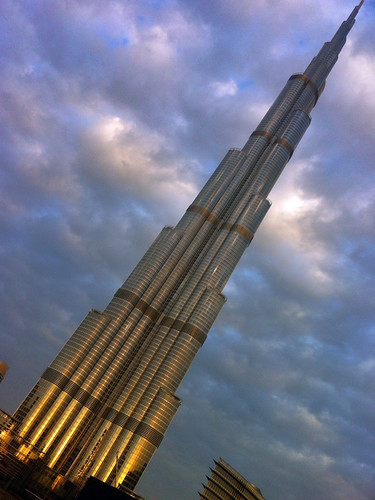
The towering Burj Khalifa - World's Tallest Building
at sunrise in Dubai
I'd looked up a lot of reviews of the city before I left, and spoke with a few friends who'd been before. I wanted to be sure that I didn't just pass through the UAE (like I passed through Japan on my way home from Singapore a few years back), but that I experienced something uniquely Dubai-an. My flight landed early in the morning and I had 9 hours until my departing flight back to Glasgow. I figured 9 hours would surely be enough for me to get through customs, leave the airport, find my way onto the train, and then over to the Burj Khalifa - the world's tallest building.
In fact, with such a short period of time in the city, I figured the only thing I'd comfortably have time to do that was unique to Dubai was to get to the Burj Khalifa, take a trip up to the observation deck, come back down and return to the airport with plenty of time to spare in case security at the airport took a while.
It was fairly easy getting out of the airport after having figure which signs meant "This way to the Arrival Hall" and then figuring out which customs line I should get in to took a little help from one of the attendants. But getting through proved no big feat, and with a US passport you can easily get out of the airport to see the city for the day. The public rail system in Dubai was super easy to use and navigate, once you had a map in front of you, but it was like no other train ride I'd been on before! It was still early in the morning and the foreign workers heading to offices and construction sites were packing into the train at every stop. The seats were lined up parallel to the sides of the trains with the rest of the interior saved for standing room. Across from me, however, the bench was full but at one stop a man from southern Asia boarded the train and just sat down on the laps of two men who were already sitting on the seat! The reactions of the two men were priceless: one was listening to his iPhone and kind of woke up, looked at the guy who'd parked half of his bum on the guy's lap, but went back to sleep. The other guy just nervously sat there, giving annoyed sideways glances at his unwelcome lap-sitter, but still never said anything! I tried imagining what the reaction in Chicago or New York would be. Surely not as passive!
I got off the train at the stop for the Burj Khalifa and headed down the very long walkway from the train station to the Dubai Mall, but it was only 9am and every single store was closed. Nothing really opens in Dubai until 10am but the mall was still open to walk around in, even if the escalators and lights weren't on. But I made my way down to the ground floor and out to Downtown Dubai, the main plaza and huge fountain/pool in front and at the base of the Burj Khalifa.
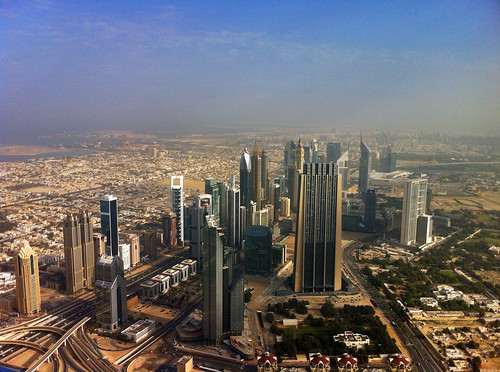
Dubai skyscrapers lining the Sheikh Zayed Road
The Burj Khalifa is the world's tallest structure, standing at 2,722 feet (over half a mile high!) and has 163 floors, of which the public can access the Observation Deck on the 124th floor (over a quarter-mile up)! Having previously purchased a ticket, I was able to get in early enough in the morning that there was no huge line-up in front of me. In fact, I had the elevator up to the Observation Deck to myself for a 60-second quick lift up those 124 floors. I was thinking the observation deck would be like the Sears Tower (Willis be damned!), all enclosed, especially being that high up, but the majority of viewing platforms were actually outside with little gaps in the 20-foot high windows that you could stick your camera out to get a clean picture. But I tell you, I get so nervous when I see people doing that, and I surely don't trust myself to not drop my phone or camera. But the views were amazing! to the north was the Persian Gulf with its beautiful blue waters. And in all other directions was desert. Miles and miles of desert. And it doesn't take much to kick up a lot of sand into the air, and even though it was barely noon, the mixture of haze and sand made viewing anything with any semblance of clarity near impossible.
With the observation deck getting more crowded with obnoxious tourists, I headed back down to the main floor, took a few more photos outside, and then hopped on the train back to the airport. I figure that the next time I'm there, I'll try and spend more time seeing the cultural sights, but doing the Burj Khalifa was enough for me for the day and I found a small lounge chair in the airport and had a little snooze before my flights to Glasgow took off.
After spending a week at a geomorphology conference (and the months before it preparing), my friend, Caitlyn and I decided it was time for a bit of sightseeing. She's been in Australia for a while and hadn't yet been down to Melbourne and since I also had not yet been down there, we found a cheap deal on tickets with EasyJet and the day after my conference ended, were on our way to Victoria where we would spend two days in Melbourne and two days driving the famous Great Ocean Road!
Melbourne (pronounced "MEL-bin" and not "mel-BORNE" as my dad likes to say) was awesome! It's the second largest city in Australia, only a half-million behind Sydney, but has been able to retain a larger amount of it's Victorian charm. A lot of people say that Sydney is the cosmopolitan international city in Australia whereas Melbourne is the cosmopolitan Australian city in Australia, and I was able to see that. The city, while big and having everything a big city must, was so much quieter than Sydney and it just felt more relaxed and easy-going. In fact, it took us a while to figure out why the city was so quiet, and we realised it is because there are no buses in the whole of the Downtown area! It's true! Melbourne has maintained its tram network, the world's largest, which dates back to 1885! And while the trams are noisy when they rumble on by, once they are gone, you don't hear anything but cars going by, which is so much quieter than buses constantly starting and stopping.
Melbourne tram in front of Flinders Street Station
We flew into Tullamarine Airport (Melbourne International) and were able to hop a bus to the city for relatively cheap, and then the bus company, after dropping us off at the Southern Cross Train Station, had other mini buses that drove us right to our hostel, free of charge! Caitlyn booked us a room in a clean hostel, right down near Federation Square, arguably the main central meeting place in the city. The hostel, the Greenhouse Backpackers, was located just around the corner from Federation Square on Flinders Lane, right in the middle of all sorts of alleyways lined with tiny cafés and coffee shops and stores of all kinds. We were super-hungry and Caitlyn, who had planned most of the goings-on of the Melbourne part of our trip, led the way east to a Chinese restaurant, Chin Chin, she heard about and we gorged ourselves on a delicious smattering of menu items. Caitlyn was always on the lookout for restaurants that didn't just offer your everyday generic menu items but something more and unique that you couldn't just get anywhere else. I was glad she'd done her research because we dined like royalty in Melbourne!
After lunch, as full as we were, we walked back toward the hostel and wandered around the lanes and alleys for a little bit, taking in some of the nearby sights including the magnificent Flinders Street Station and St. Paul's Cathedral. It felt a bit odd walking around because it was early December and everything was decked out in Christmas decorations all over the city, but it was HOT! It was such a weird feeling seeing and hearing all the Christmas cheer without the cold and the snow that we are used to back home in Michigan! But our destination was another place Caitlyn had heard about called, Little Cupcakes. After walking past it two or three times, we finally found it and stepped in for a wee coffee and some of the dare I say cutest cupcakes I'd ever seen!
It was still early in the afternoon and we decided we'd walk off our lunch on the way to the Old Melbourne Gaol (jail), an historic building in both the city's and Australia's past. We got there right before the last tour started, and while it was a bit more expensive than the general ticket to get in, it was SO worth it! You get put in a group that is led into the Gaol as if you had been arrested. The men are lined up across from the women and everyone is given an inmate card with the background of a convict and then your guide, the Warden, makes it very clear that you are to follow all rules of the Gaol and address him or her as Sir or Ma'am throughout the tour. It's kind of funny at times, but if you have a good guide, like we did, you quickly become afraid of stepping out of line (though humourous comments were appreciated). The warden checks you for any contraband and then leads you into the holding cells for the inmates, one of which is a giant padded room, and you learn how certain inmates, like the pedophiles, get a separate outdoor space in the yard during physical activity time because otherwise they'd surely be beaten to a pulp by the other inmates. It seems short, but the tour took about half an hour and culminated in a photo op where you get to hold up the inmate clapboard and have your mugshot taken! The tour only takes you through the holding cells, but the other half of the Gaol is in the main Men's hall - three stories of cells just like in the movies, lining a central corridor with walkways around the perimeter and stairways at the ends. In each cell you learn about specific convicts, or about jailed women, or immigrants, or whatever the case may be, but the Gaol is almost most famous for being where Ned Kelly, the famous Australian outlaw, had his last meal before being hanged.
Thoroughly worn out by history, Caitlyn and I headed back toward the hostel, but not without stopping at the James Squire brewhouse (which I thought was just a Melbourne thing, but apparently the first James Squire brewery is along the Parramatta River near Sydney). The beer was good anyway and we were back to the hostel soon enough for a wee nap before once again heading out for more alcohol and food! We got dressed up a bit and Caitlyn lead the way to Mamasita for some delicious late-night Mexican food and drinks in this upstairs restaurant that was well-worth the 20-minute wait for a table! Good food, delicious drinks, and great music put us right in the mood to find a place to go out for the evening. And while we asked around for a good place to find free live music, no one could tell us of anything nearby aside from places with $20 covers, so we went off to find our own adventure.
And find it we did in the form of Cherry Bar on AC/DC Lane where there was a live band covering The Doors in celebration of Jim Morrison's birthday. It wasn't really a dive-bar per se in that it was crowded, loud, and everyone was having a great time! The band played for another hour or so before calling it quits, and we followed suit, headed back to the hostel and crashed pretty quickly into bed.
We woke up early the next morning and headed off to one of the nearby cafés in the alley-ways for a good breakfast place. We found a place, and it was good, but the food was pretty generic, and not much to remember. Caitlyn wanted to do a bit of shopping so we stopped in a few stores and then headed out to the Queen Victoria Markets which are the largest open-air markets in the Southern Hemisphere. Frankly, I was pretty unimpressed; the market stalls were filled with the usual knick-knacks, Aussie t-shirts, and iPhone covers that you can find in Sydney's Paddy's Markets. Maybe the produce was good, but we weren't planning on cooking, and there was only one aisle, off to the side, where local Melbournian vendors were selling their art. Needless to say, we didn't stay long but made our way over to La Trobe street and hopped on one of the free trams that loops the Downtown area.
Back at Federation Square, Caitlyn and I decided to split up for a few hours. She stayed in the Square and stopped into the Australian Centre for the Moving Image and National Gallery of Victoria and I took my camera and headed off to the massive Botanical Gardens. While much of Melbourne is relatively flat, the Botanical Gardens are anything but! Paths wander in and out of groves and parks and plazas and statues of royalty, but I eventually found myself looking up at the the Shrine of Remembrance, Melbourne's ANZAC (Australia and New Zealand Army Corps) Memorial. Sydney's is nice, but Melbourne's is Grand! I hadn't planned on spending as much time as I did there, but the memorial is so full of symbolism in the carved reliefs high up in the central sanctuary and an outer hall with the flags of each of the main branches of the armed services. You find marvelous views of Melbourne's skyline from the rooftop terrace of the Memorial and down in the crypts are more rooms honoring fallen soldiers and special moments in military history.
Looking at my watch, I needed to get a move on to meet Caitlyn back at the hostel but I still had a bit more of the Botanical Gardens to walk through, and I was going to go a little out of my way to see the Melbourne Olympic Stadium (which I found out is actually the Cricket Grounds and farther than I was willing to walk!). But I did walk along Batman Avenue and I passed the Rod Laver Arena where the Australian Open is held.
The afternoon was drawing on and after rendezvousing, we headed out to the suburb of Fitzroy to have dinner and beers at the Little Creatures Dining Hall where we had delicious pizza and amazing doughnuts!! Fitzroy reminded me a lot of Burlington, Vermont, with its anything-goes attitude, hole-in-the-wall boutiques and cafes, and somewhat bohemian vibe. I think it was in Fitzroy that we decided what we'd do with the rest of our evening and concluded that the best option would be to go to an open-air cinema in St. Kilda, hosted by Ben & Jerry's Ice Cream to see a showing of the sing-a-long version of Grease! Haha.
The trams took us from Fitzroy down to St. Kilda and there was plenty of time before the movie started for us to walk out to the end of the St. Kilda Pier Breakwater where the Lonely Planet Guidebook mentioned we could see tiny fairy penguins swim ashore to their nests in the rocks of the breakwater at sundown. Not too many people were out on the breakwater when we got there which allowed us to enjoy a little bit of fresh air out and watch kite surfers on Port Phillip Bay in front of the Melbourne skyline. We didn't see any penguins swimming ashore, but more people were coming out to the breakwater and soon we noticed tourists pointing between the rocks and shoving their cameras into the holes. Clearly, there were nesting penguins already ashore and we walked right past them! I kind of felt bad for the little penguins, having all those cameras and flashes being shoved in their faces, but they took it like champs and either didn't notice or pretended not to, anyway. I was conflicted because I didn't want to be part of the mob, but these were the first penguins I'd seen in the wild and had to have my own proof, so I briefly joined the mob of tourists, took my photo and left. The sun was actually setting now, so we headed over to the open-air cinema, got our free samples of B&J ice cream, rented some seats (and blankets because it was windy and freezing!), and kicked back to enjoy singing along to Danny and Sandy, Frenchie, Rizzo, Jan, Kenicke, Doodie, and the other guy. I should have known, or realised before, but it only dawned on me that Sandy was a new student from Australia, played by then-breakout-star Olivia Newton-John. Who knew? Apparently everyone else.
Once the movie was over, Caitlyn and I headed back into town to get some sleep before our road-trip started the next morning. But before any good road-trip can start, one must have a good, filling breakfast, and Caitlyn was back on top of things and we found ourselves the next morning having an amazing breakfast at The Hardware Sociéte where I wish I could remember what I had for brekkie because it was to die for! And Caitlyn was in Heaven, too, snapping photos of the light and cheerful café before heading back to the hostel one last time to pick up our bags and then it was off to pick up the rental car for our journey along the Great Ocean Road!
Sometimes it's nice just to get out for a wee bit of fresh air. Wayyy back in October, I did just that. On an overcast Sunday, I decided that I would continue my coastal walking excursions, but instead of continuing on the south side of Sydney Harbour (like I did from the South Head to Bondi or Bondi to Maroubra Beaches), I wanted to give the north side of the Harbour a try. I took the ferry from Circular Quay out to Manly - a great beachside suburb - and just started walking.
Sydney Panorama
Sydney is a fantastic city if you want to get out into a wilderness park without really leaving the city. Sydney Harbour National Park is made up of numerous parcels of land all throughout the area, most with access to the Harbour itself, and the North Head of the Harbour is no exception. As you walk, you quickly leave behind the busy suburban life and find yourself walking across small beaches at the heads of tiny inlets off the Harbour. And you see wildlife, too! One of the animals I have yet to see - though I haven't really sought it out yet - is the Sydney Harbour's population of Little Penguins. Apparently, there are only a few breeding pairs that call the Harbour their home and they all make their nests around the Manly and Fairlight suburbs. In fact, along the walking path from Manly to Fairlight, you see notices painted on the sidewalk telling you to watch out for the little penguins, which only grow to be a few tens of centimetres tall! From Manly out to the North Head, you see the signs telling you that you're in the penguin habitat, but they don't tell you where they actually are - nor will the locals divulge the nesting locations - because they want them to be protected from suburban dangers like dogs, cats, boats, and overzealous tourists - which, believe me, Sydney has and they all go out to Manly! If I were a Sydney Harbour penguin, I would be glad my nest was a secret worth keeping!
Further along, the path led back to a few houses and up to a former military training ground that is now being completely renovated into a community-led initiative focusing on the unique habitats the North Head protects. In fact, you frequently see signs warning you to keep an eye out for bandicoots - little weasel-like marsupials that were once very common throughout the Sydney area. While their populations in the suburbs are fairly healthy, the population of bandicoots in the National Park at the North Head is very very small. In fact, a hotel at the old Sydney Quarantine Station, has it written into their contract that if more than 7 bandicoots are killed by cars driving in or out, they will lose their business licence, so vehicle traffic to and from the hotel is limited in the evening, night, and morning hours when the bandicoots are most active. A colleague of mine also told me that a few years ago, a fox got in to the National Park and wreaked havoc on the bandicoot population, killing 6 bandicoots, thus reducing the gene pool by something like 20%!
So the North Head really is a little sanctuary of wilderness in the big Sydney city! At one of the welcome stations, I spoke with a volunteer who told me of the other wildlife in the park, including echidnas. Echidnas are one of the three species of monotremes - or egg-laying mammals - in the world (platypus and the long-beaked echidna are the other two). They look like mini porcupines or engorged hedgehogs, and their hind legs are twisted around to help them burrow. Anyway, the volunteer told me that they are not uncommon sightings in the park, but I was highly unlikely to see one. And with that, I had a goal for the day!
Continuing on along a raised metal-grate walkway (which is such a great idea for national parks to have because plants can grow under it, animals can pass underneath, and the only damage to the land are the post-holes for the walkway supports), I headed toward the view point at the very tip of the Harbour.
The amazing thing about the Australian coast around Sydney is that you have your nice wide sandy beaches, but between them are these massively huge sandstone cliffs that drop into the ocean and are eroded by the salty waves below. Just like on the South Head, there are battlements built up all around the North Head to protect Sydney Harbour during the World Wars. Many of the constructions still remain today and are built in to the scenic lookouts.
Being October, it was a little late for the main right and sperm whale migrations, but at one of the lookouts, I noticed that a Sydney whale-watching boat was out in the ocean and since it guarantees its customers to see a whale, I figured I'd see if I could see anything. I had no luck, but a man who was there with his family was more patient than me, and sure enough, he saw the tell-tale sign of a whale's presence: the steam from the blowhole! We determined there were two whales, very far away, and they would only come up every five minutes or so, so it seemed like forever waiting for them to come back to the surface. Thankfully, I had my DSLR camera with the telephoto lens and while you can't really see the whales in the photo, you can see the breaking water and blowing mist as they breached. And then, wouldn't you believe it, just beneath the cliffs below us a small pod of dolphins was spotted and I watched them for a good ten minutes before they turned and went in a different direction.
The view of the city and the South Head from the lookout is fantastic, even on a gray day, like when I was there. You really get a sense of just how big Sydney Harbour is, how rough its coast is, and how green and beautiful the city is on the hills surrounding the Harbour. I started to head back to the path, because I wanted to find the correct trail down to Manly Beach, and just before I got to the parking lot for the North Head lookout, I saw a few people gathered on the walkway looking at something. I got a little closer and was surprised and excited to see an echidna digging and scratching in the dirt just off the sidewalk, looking for his dinner. They really are bizarre looking little guys! He took no notice of our small crowd and maybe even posed for a few camera shots! I felt lucky to have been able to see another Australian animal that many Australians haven't seen outside of the zoo (and I've seen 5 of them!).
I got back on the path and saw a sign pointing toward some rare cliff-top swamps or bogs that are just perched on top of the flat sandstone and decided to take a little detour. The walk was great and almost no one else was on it. The metal walkway seemed to hover over these perfectly still ponds while dragonflies and birds zoomed around.
Soon enough, though, I was back on the trail and working my way over to Manly Beach. The sun was beginning to get low in the sky, turning it a nice pink color, but off in the distance, well north of Sydney I could see the rising smoke of controlled fire-burns being lit to limit the advance of a real bush fire, should one occur during the summer months. A few years back, a big bush fire did burn its way through Lane Cove National Park right out near Macquarie University, where I study, so the chances of a fire coming close to the city are very real and all precautions in the outer suburbs are taken to prevent loss of life and property.
Manly, the North Head, and the ferry ride back into the city are some of my favorite spots in Sydney. This walk was the last time I was out that way and after writing this, I have an urge to make another visit soon!
Not having a car in Glasgow is really liberating. I don't have to find parking spaces, don't have to worry about theft or vandalism, and don't need to worry about insurance or anything like that. What is frustrating is that on the weekends, if I want to take a trip somewhere, I'm somewhat limited by wherever the train goes (granted, the trains go to a million different places, but not to every site to see in the country). I could always rent one; it wouldn't be too difficult. But I hate to say that just haven't put in the effort to doing that. I should. It will help me learn to drive on the left side of the road both here and while doing fieldwork in Australia, but I just haven't.
What I did take the effort to do yesterday, though, was to get out of the city and do a little sightseeing. I really wanted to go out and visit some of the Islands or the Highlands, but being train- and time-limited (I woke up at half ten...) I decided for something closer. An officemate of mine mentioned before I left that a neat place to visit is Culzean Castle (pronounced kil-ane), about 50 miles south of Glasgow.
Getting there was a little bit of a trip in and of itself. The train left from Glasgow's Central Station in the city center, so I took the subway downtown and then walked over to the station from there (sidenote: Glasgow really should consider running a spur subway track from either Buchanan Street or St. Enoch stations to Glasgow Central...). I bought a ticket to the coastal town of Ayr, about an hour's ride away.
I was surprised by how many people were going to Ayr yesterday. I've taken the train before and it's never been as packed as it was. And not just packed with regular people, but packed with loads of highly make-uped women in fancy dresses and silly wide-brimmed hats and men in sharp suits with snazzy, shiny pointed-shoes. I asked the man sitting next to me if there was a holiday or something going on that weekend and he mentioned that the Grand National horse race (a two-day, multi-event, festivity considered to be the best of its type) was being held at the race course in Ayr. Mystery solved. Looking at my phone, I found out that tickets to the race were only £19, but I decided to go with my original plan since I was definitely not dressed for such a fancy event!
Once in Ayr, I walked a few blocks from the train station to the bus station (note: the personnel at the train station do not know where the bus station is), which is not altogether easy to find from the train station. But I got there and about ten minutes later, I boarded the bus, and was off for Culzean Castle.
I was worried that the weather was not going to be nice for the trip, hence my late morning-rise and hesitation about going on the trip in the first place, but the skies cleared up for most of the day so that I was warm wearing my sweater and button-up shirt. From the bus stop at Culzean, you walk about 20 minutes to get to the Visitor Center which is housed in a ring of former farm storage sheds (I use the term sheds lightly here). Like all Visitor Centers, this was no different with the obligatory cafe, gift shop, toy shop, and toilets, but they also have a 20-minute video presentation that I never did see...oops.
From the VC it's a ten-minute walk to the castle, which was designed by Robert Adam for David Kennedy, the 10th Earl of Cassillis, who provided Adam with the funds to turn what was just an old medieval tower house into an architectural masterpiece, considered to be Adams's best. While the house and lands remained in the Kennedy family since it was built in 1793, they were donated to the National Trust for Scotland in 1945 so that the Kennedy family could avoid Scotland's (UK's?) inheritance tax, which is imposed on any property or possessions handed down to an heir after the owner's death. Often, with large estates such as Culzean, the tax can diminish the heir's inheritance significantly and if the heir doesn't have their own business or other means to pay the tax, they may not be able to afford their inheritance and thus the estate may be sold to the National Trust to be accessible to the public. Such was the case with Culzean, although, the family did stipulate that the third floor of the house be available to President Eisenhower in recognition of his efforts during World War II. The President did use the apartment numerous times during and after his presidency, but now the apartment is available to be rented out to anyone wanting to spend a night in the Castle!
Walking up to the castle, you enter through a ruined archway and over a viaduct designed by Robert Adams to give the feeling to any visitors that the castle was seemingly floating over the landscape. The views of the castle from the ruined archway and the viaduct are fantastic and you get views of the palatial gardens behind the house. The castle is positioned right on top of a cliff and the cliff edge is lined by a balustrade and observation deck looking out to the Isle of Arran across the Firth of Clyde. Off the driveway, opposite of the castle, is a stables building with a beautiful clock tower (which I didn't go in, and now I'm not sure why). You have to pay to get into the Castle separately from what you pay to get in to the grounds, and I just didn't want to put down those few extra £££s, but I will do that next time because the inside is supposed to be fantastic. I just didn't really have the time to explore the grounds and the castle since I arrived at 1:30 and the last bus back to Ayr left the main road at 5:00.
But I walked around the perfectly manicured gardens, across spacious lawns and eventually went down to the beaches below the cliffs where there is an older boathouse and another small manor which I'm not sure what it was used for initially, but now houses an environmental education center. Most of the grounds at Culzean are covered in woodlands with many paths and walks to explore, so I followed the coastal path up above the rocky shoreline for a ways until it popped me back out at the western end of the estate at the Swan Pond which has been a feature of the estate since it's beginnings. Overlooking the pond from a hill is a Pagoda which used to be common on estate grounds of the day and the Kennedy family used their to house exotic animals such as monkeys and likely also housed large birds like swans. You can still see all the cages of the Pagoda, which was restored back in the '60s, but not much else up there.
The Swan Pond itself is much more interesting. There is a little ice cream parlor in what used to be the living room of another little summer cottage on the estate, which also was where the family kept their chickens and other poultry. Lining the edge of the pond near the ice cream parlor is a little walkway and balustrade where you can sit, people-watch, and enjoy the antics of dozens of ducks, swans, a few gannets and herons, and other birds.
And today was no exception. I noticed a lot of the mallards acting strangely as they'd quickly dive under the water and kind of burst back out, splashing water everywhere, kind of rearing up and stretching out their wings. They were all doing it, but I couldn't figure out why until I saw a female duck enter the water only to be propositioned by four mallards, competing to win the affections of the female duck. Welcome to ducky mating season! The ducks kind of have a nice life at the Swan Pond and on a wee island about 10 feet from the edge of the pond, the ducks even have an architecturally elegant, octagonal, 24-coop duck house. But antics like these are not without their dangers. A man and his wife were there with their dog and was letting the dog off the leash. It was cute at first when the dog charged into the water sending all the ducks flying in different directions, but it soon became apparent that the owners had no control over their dog. Millie (the dog) was chasing ducks in all different directions and unfortunately chased a mother duck who had about ten ducklings in toe. Of course the ducklings couldn't yet fly and they tried desperately to scatter away from the dog. Waiting nearby, on the edges of the pond, were some seagulls. I'm not talking little squakers from the beach, but big, brutes. Well, one of the seagulls, apparently fed up with eating garbage and bread crumbs from children, took advantage of the disarray, swooped in, and picked up one of the disoriented ducklings and carried him off. Remember, there are children around the pond watching all of this and other people are remarking on how the seagull just snatched up a baby duck. By this point, the owner of the dog is shouting for her to come back, "Millie! Millie! Get back here!!" and his wife is trying to get the dog back as well, but less aggressively, "Come here, Millie," in a singsongy voice. The dog just kind of looks a them and continues his chase. Now, however, parents of the children, annoyed at the spectacle and lack of control the man had over his dog, are now suggesting out loud that the man go into the pond to get his dog. Another parent admonishes the owner for allowing his dog to disrupt a pleasant afternoon and getting a baby duck killed. And so on. Eventually Millie returns to her owners, and they put her on the leash and call her a bad girl, walking away from the pond to leers and jeers from on-lookers. Even then, once the dog was gone, people were still watching the seagull, who now was occupying some space near a log, thrashing the dead duckling by its neck. I looked around for the other nine ducklings but only saw one swimming around. I'm hoping that the others found safety in the coops on the island, but I'm not convinced.
So with that, I decided to leave the Swan Pond and made my way back to the main Castle and set out to find the walled gardens. These gardens are quite extensive, though there is a lot of space between rows of flowers and trees. It would be a nice place to relax and walk around, but by this time, the weather started to turn nasty and rain was coming down. I waited a while in the vinery before sloughing back through the rain to take a few photos at the Deer Park and then back to the Visitor Center where I got a plastic bag to wrap my camera in and then headed back out to the main road to wait for the bus back to Ayr (which almost didn't happen as the bus just sped passed the bus stop even though there were five of us in there, making us run out to catch the bus, which did stop but was pulled off the side of the road well away from the stop).
It was a nice day, overall, and it was nice to use the train and bus systems once more to get out of Glasgow. I'd definitely go back as there are a few things I missed out on such as the tour of the Castle, fortified caves below the castle (off-limits to visitors except on rare ranger-led guides), and a series of gates in a random, wooded corner of the estate. But I think my next excursion out of town will have to be to the islands or the highlands as I have yet to experience them.
**Photos are at the bottom. There will be many more from this weekend. Just haven't gotten that far yet!
Wow! What a whirlwind weekend! A few weeks ago one of my classmates, Rebecca, told us she was going home to Northern Ireland and any of us who wanted could join her in Belfast while she was there visiting some of her friends before they moved elsewhere. But that's besides the point. The important thing is that after some careful consideration decided it was in my best interest to celebrate St. Paddy's (not Patty's) in Belfast because, really, when would I have the chance to do that again. Certainly not next year when I'm in Australia.
Rebecca left on Thursday for Northern Ireland to visit her family a few hours out of Belfast and that night I went to see Monty Python's Spamalot with some friends at the beautiful King's Theatre in the Glasgow City Center. It's a hilarious musical with awesome music, though I have to admit that many of the jokes were totally lost on me. Nevertheless, I've been wanting to see it for a while and finally got the chance. We grabbed a few drinks after the show, but what I thought was going to be a sort-of late night, ended up being a very very late night and I ended up crawling home at 3am and climbed into bed.
It was important to get up early the next morning because I had to get to the city center to catch a train, which would take me to a bus, which would take me to a car/passenger ferry, which would take me to Belfast. It's a great package deal called the Rail and Sail: for £54 you get a return foot passenger ticket right from Glasgow to Belfast!
Since I didn't get a whole lot of sleep and still had to pack, I was in a fluster when I woke up. I made myself breakfast and packed what I thought I needed and was planning on heading to school quickly to pick up some papers to read on the train and ferry. I hate mornings and can never get going and before I knew it, I was turning the corner to the Partick Train Station with 20 minutes to spare before my train left. The trouble is that my train was leaving from the Central Station in the city center, which was definitely more than 20 minutes away, even if the subway got to Partick right on time. Luckily, there was a whole stand of taxis ready to go, so I climbed in the first one and told him to book it to Central Station. He was in no such hurry, and I kept looking at my phone, watching the minutes count down.
We finally pulled up to Central Station and the station clocks read 11:38 when I walked in (my train was supposed to leave at 11:42). There were too many monitors for me to make sense of anything with such little time left, but I couldn't find a station agent anywhere, so I walked around the waiting area a few times before I found someone and asked from which platform the Rail and Sail train was leaving. The lady frowned and said the direct train already left. My heart sank, but I wasn't giving up. My recollection from getting my tickets was that I needed to catch a bus at some point, so I asked about the 11:42 train. Something clicked in the agent's mind and she realized that my ticket was not the direct ticket and told me I should just be able to catch the train from Platform 10 to Ayr. I thanked her and booked it for the platform, and just as I sat down on the train, I felt it lurch forward. The luck of the Irish was truly on my side that morning.
The journey from Glasgow to the small town of Ayr was not too spectacular, and neither was the bus ride from Ayr to Stranraer. It was raining and since I was still fairly sleep-deprived, I just plugged into my iPod and dozed off. The bus did start following a road right along the ocean once we got to Girvan and if the sun had been out, the views of the Northern Irish Sea would have been amazing! But even in the rain, the town of Girvan looked idyllic, with seaside cottages built right up to the edge of the water! It wasn't much longer until the pulled into the Stena Line ferry docks on Loch Ryan and I easily passed through security (airport style), got a mocha for my caffeine fix, found an outlet to plug my iPod in, and connected to the free wifi so I could download a few of the papers I didn't have time to retrieve that morning.
Soon enough they called everyone onto the boat and let me tell you, it was a ZOO! I'm not sure how many people can fit in the boat, but it was packed to the gills. There were tons of people heading to Belfast; lots of young people heading to Belfast for St. Paddy's Day, including some unforgivingly stereotypical American backpackers, and even a group of young teenage boys wearing pink bunny suits (I'm still lost on that one!). Belfast was going to be an exciting weekend, not only because of St. Paddy's Day, but also because it was the final weekend of the Six Nations Rugby Tournament and Ireland (that's both Northern and the Republic) was playing England in the final match. BIG GAME! But the boat was beautiful and new. There was a typical food-court style room and seating area filling the main deck and on the deck above there were more refined and quieter seating areas with iPads, news casts, a cinema, and a trucker's club. What's more is that the ship also has a fully functional hotel and day spa you can treat yourself to for a few extra quid!
I was fortunate enough to find a big comfy seat in front of a large window and it didn't take long before the massive ship was pulling away from the docks. Sleep deprivation finally caught up to me and I passed out, sleeping most of the way across the water. I did wake up in time, though, to take my camera and head outside to the smoking decks as we were pulling into Belfast harbor. It was still drizzly, but I managed to snap a few (hundred) photos of the harbor, including the famed cranes with the monikers, Samson and Goliath, of the Harland and Wolff shipbuilding company. In the corner of the harbor is a beautiful new building that will house the Titanic Museum, slated to open this year, celebrating the centennial of the ship's inaugural, final, and infamous voyage (which is interestingly enough in the news recently as a new hypothesis was put forward suggesting an unusually strong gravitational pull from the sun and moon caused super high tides three months earlier, allowing for a massive iceberg to float so far south).
The ferry's captain effortlessly steered the boat into it's slip along the harbor and everyone disembarked rather quickly. I phoned Rebecca to let her know I was safely in Belfast and we arranged plans to meet up in the city center, so I caught a city bus from the ferry terminal to City Hall - a very, very easy connection to make (and cheap, too).
Belfast has a reputation for being dangerous, rowdy, and riotous and the fears are not totally unfounded what with the Troubles, severe border control, and the recent St. Patrick's Day riots of 2009. The last decade, though, has seen a sharp decrease in the amount of violence between the Protestant and Catholic Irish factions within the city, though in many places and in certain pubs you'd best not talk about the wrong sports team, political party, or religion, because in Belfast, they are often all one-in-the-same. While my family was in [the Republic of] Ireland this summer, my brother and his fiance were in Belfast, and though I may not remember what they said exactly, I seem to think they were glad they didn't stay too long. As soon as I got off the bus in the city center, I wondered why.
Downtown Belfast is beautiful! Especially at night when everything is lit up. I took a few photos of the City Hall while Rebecca came to find me. We grabbed dinner at a very fancy little restaurant called, Deane's, for some upscale seafood (who knew that fish pie could be so good? oh, and they have a desert or salad and dinner for £14 sometimes) and then got some suggestions on pubs from our server who directed to a place called the Duke of York. Well, we did not find the Duke of York, but instead came across the Bittles Bar. Bittles is incredibly tiny, occupying the corner of a very narrow triangular building, and no more than 10 tables inside with one bartender running the whole show. But there were paintings of historic Irish athletes (George Best, Barry McGuigan) and politicians including one of an embrace between the leaders of the Protestant and Catholic political factions. Rebecca and I chatted away in the corner underneath a painting of the Titanic, but we didn't stay for too long as some very drunk fellows at the next table over were getting to be a little too unpredictable.
With our Guinnesses finished, we walked back across town to the Crown Bar Liquor Saloon, which is where many laborers would stop in for a wee pint after a day's work. It's famous for being opened by an Irish man and his English wife - which is odd to begin with - but the story goes, or so I'm told, that the woman desperately wanted to name the bar the Crown Bar in honor of the British crown. Her husband agreed, surprisingly, and offered to have a crown beautifully displayed....in mosaiced tiles on the floor when you walk in so you step on the crown every time you walk in for a drink. Again, that's the way the story goes and I can't confirm it right now. But the Crown Bar is a masterpiece of tiled mosaics, carved wood, tin ceiling tiles, stained glass, and metal work. The main bar area has no tables, though there are 10 fully-enclosed booths in the bar for private discussions between patrons. Above the bar is a board with 10 circular holes each assigned a letter A-J that corresponded to a specific booth. If you needed something from the bartender, you would just hit a button in your booth and the corresponding light turned on, and you would soon get service without losing privacy. Awesome place and definitely work a peek when you're in Belfast!
The night was getting on and we started heading back to Rebecca's aunt and uncle's flat where we were staying while they were out of town. On the way, though, we stopped in one more pub called Filthy McNasty's where we topped off with another few pints of Guinness before calling it a night. We hailed a cab to take us the rest of the way. Rebecca asked me, on the way back to Glasgow on Sunday, if I noticed that the cabbies wanted to know where you wanted to before you got in because many cab drivers will not drive into certain parts of town as they can just be too volatile. But where we were going was fine and we soon crashed into bed without alarms set so we could just sleep.
(Either I've been itching to write for a while or my memory of last weekend is just still so clear that I have a lot to write about! More coming soon, but I've got to go to bed!)
I left Glasgow on Saturday morning (the 3rd) and shortly landed at the KLM/Delta European hub, the Schipol Airport near Amsterdam. My flight schedule had me on a 24-hour layover in Amsterdam (my choice) and I fully intended to enjoy some time in the city. Before I left for Glasgow, I booked a bed at a hostel on the outside of the city center, but right next to the museum campus. I was hoping to find something closer to the city center, but many hostels won't let you book a single bed over a weekend for just one night; instead, you have to book a minimum of 2-3 nights. Getting to the hostel wasn't bad, though. Once I got through customs, it was pretty easy for me to find a ticket agent and buy a round-trip train ticket, though the woman behind the counter gave me a look of disdain when I started speaking in English.
The train system was familiar since I spent so much time in Berlin earlier this year, and no more than twenty minutes later, I arrived at the main train station in downtown Amsterdam. It's a beautiful building, architecturally, though much of it was covered in scaffolding and being refurbished. I bought a street map of the city from the Tourist Information center just across the street from Centraal Station. Though it was early in the afternoon, the sky was getting a little cloudy and started to rain a little bit, but it didn't bother me as I started wandering through the streets of Amsterdam.
I didn't take too much time to get lost in the city because I wanted to get to my hostel and check in, making sure I had a bed for that night. A number of trams and buses run throughout the city and there is a subway system set up, though it doesn't really get you many places in the city, but I decided to walk. Afterall, it didn't look far, and I was short on change. I did find out before I went about the I Amsterdam card, which give you total access to any public transportation system as well as access to dozens of museums around the city. I thought about purchasing this card, but even for the 1-day offer, it was going to be more expensive than walking and buying my entrance to the one museum I had time for.
Amsterdam is one of those fantastically cool, walkable, friendly, cheery, beautiful cities. It is of course famous for its extensive series of canals, which were recently added to the UNESCO list of culturally significant sites. One of the other things that immediately stands out as being unique among European cities is the architecture of the houses, the majority of which can't be more than 15-feet wide. Though skinny, each building is deep and rises 4-5 stories above street-level, and is crowned by a little ornamental façade. Naturally, this design made it difficult to move large pieces of furniture up and down stairs, so many of the houses have a pulley system in place near the roof line so that you could hoist large items up and through windows. And of course there are the canals - beautifully lined with trees along the sidewalk and boats in the water. I've never been to Venice, and while I imagine it is more austere, Amsterdam's canals just seemed inviting and quaint.
Tree-lined canal in Amsterdam
I got to my hostel, the Hotel Annemarie, and had a little problem checking in because I thought I paid for everything online at www.hostelworld.com, but it turns out they only take the deposit and you have to pay the rest upon arrival - but the hostel may or may not take credit cards. Such was the case and I had to run around the corner to find an geldautomat (ATM) and get some money. Wasn't too big of a deal, but I also had to put to a refundable deposit for my key, which was just slightly annoying. But the host at the hostel was a very cheery man with a more than friendly disposition and every time I saw him he asked me by name, "Eric, how is your stay? Eric, how are the rooms? Eric, is there anything I can do for you?" And to be fair to the 75% rating on hostelworld.com, Hotel Annemarie was very nice - definitely not a party hostel.
I went up to my bed - one of eight in the room - and took advantage of the free wifi and tried calling home with my computer. But it turns out that voice calling from the Gmail chat window has been modified and it is no longer free to call the US internationally... So I checked my email, made my bed, and then put my things in my backpack and headed out to check out a museum while they were still open. Most close at 6pm on a daily basis, so I didn't have much time. Luckily, Hotel Annemarie is adjacent to the museum campus where the Van Gogh Museum and Rijksmuseum are located.
My first instinct was to go to the Van Gogh Museum and get my fill of the renowned artist, but I ran into another snafu because I didn't have much cash and the minimum to use a card was 25-euro... Luckily, the Rijksmuseum is just down the street and I was easily able to get in. The Rijksmuseum is a clearinghouse for all things Dutch. It covers aspects of Dutch history, culture, and art and has many fascinating displays. The museum has been undergoing a series of renovations so the majority of the museum is inaccessible; instead, they've had to condense their art and artifacts down to the most popular.
I had to go through fairly quickly, but was able to learn that the Netherlands gained its independence from Spain in the 1500s and refers to various autonomous regions within the political confines of what we recognize today. Holland, though synonymous with the Netherlands, is really just one of those autonomous regions. Anyway, the Netherlands quickly became a powerhouse of sea-trading and exploration, colonizing parts of North America (New Amsterdam became New York City), South America (Suriname), Africa (parts of South Africa), and southeast Asia (Indonesia). Somewhere along the way, the Netherlands transitioned into being governed by a monarchy...I missed that transition, though - or maybe that display was in the closed-off portion of the museum?
The tour then brought me through a few rooms complete with jewelery, gems, and other fancy accoutrements of the rich and famous and a room full of delftware, a type of blue and white ceramic in which pictures of Dutch life, designs, flowers, and landscapes are depicted.
But the main attraction at the Rijksmuseum is the vast artwork collection with pieces by Rembrandt, Vermeer, Hals, and Steen. I am not an art historian and don't really understand the intricacies of the various media or techniques used, but I can appreciate the talent that goes into portraying the Dutch landscapes, the symbolism represented in various party scenes, the detail in portraits, and the sheer magnitude of the museum's most famous piece, Rembrandt's "The Night Watch" - a huge 12-by-14 foot mural of guardsmen from Amsterdam's upper-crust. It's a beautifully detailed painting that is somehow still around today after being trimmed down on three sides when it was moved to a secondary location that wasn't as big as its original and then more recently being ripped apart in places after a deranged man slashed through the painting in many places with a knife.
Rembrandt's The Night Watch in the Rijksmuseum (photo: Rijksmuseum.nl)
I left the museum right around closing time at 6pm, and didn't really feel like walking all the way back into town for a night out by myself, so I grabbed some food from a nearby grocery store and went back to my hostel to eat. Back in my room, three girls from Spain were getting ready for their night out on the town, but the other beds were empty. This was good news because it meant that our room was maybe not going to be too crowded. Sure, I might have to deal with them coming back late that night, but I could put up with that. I finished reading my book and checked emails until my battery ran out, but by that time, a giggly and talkative group of French students (and one Swede) came into the room speaking the whole time in French. I tried to just ignore them, but one of the guys and I chatted for a little bit. They were confused why I was staying at a hostel in Amsterdam but wasn't going out for the night. I tried explaining that I was on business (of sorts) and just here during a layover. I don't think they understood. They continued to get ready while I, running out of things to do, pretended to study a map of the city.
They eventually left, apologizing in advance for when they came back later that night, and I tried to get as much sleep as possible because I knew that later on, when everyone returned, I'd be woken up again. Well, the Spanish girls did not return, which I thought was weird, but it was good because there weren't enough beds for me, the three of them, and the five french students, and when the students returned they were loud, but not obnoxiously and I prepared for the light by putting my airplane eye-shades on. Wasn't too bad.
I wanted to wear ear plugs, too, but I wouldn't have heard my alarms go off on my iPhone, which I had tucked into the hood of my jacket hanging off the post of my bunk bed. I ended up waking up before my alarm went off and decided to be nice to my roommates and turned my alarms off before hopping in the shower so they wouldn't be woken up either. I took my shower and started packing my bag in the dark so I wouldn't bother them by turning on a light, and nearly had everything together when I went to put my iPhone in my pocket...but it wasn't there in my jacket's hood where I left it. I felt through all the pockets in my jacket to see if I just misplaced it. But I was positive it had been in my hood because that's where I put it when I turned my alarms off so my roommates wouldn't be woken by it. It just wasn't there. I thought maybe I left it in the pockets in my shorts, so I emptied my backpack and checked everywhere. Couldn't be found. I checked my jacket again, and then shook my sheets, and then my backpack again. Jacket. Backpack. Jacket. Backpack. It was nowhere to be found. I started getting really psyched out that someone, again, had stolen my iPhone, exactly like what happened when I was on my way to the Berlin airport earlier this year.
I started to freak out and I turned on one of the lights, which woke up one of the French girls, so I muttered, "Désolé. J'ai perdu mon mobile." She asked me to let the cat out of the room because it was bothering her. When did a cat come into the room? So I let it out and continued my search. Maybe it fell into the sheets of one of the two beds below? I couldn't quite justify rummaging my hands through the beds where a girl in one and a guy in the other were sleeping, so I flattened myself on the floor and rechecked under the beds. There, with the light on, I could see a little box-like thing near the wall under the bed. It was my phone! I grabbed it just to make sure, let out a big sigh of relief, and stuffed everything back into my backpack and headed downstairs for a meager breakfast of toast and jam.
It wasn't that late and I was going to make my flight, no worries, but I quickly left the hostel and started my way back to Centraal Station. But what good is a stay in Amsterdam without a visit to the Red Light District? The district is famous for its provocative nightlife and adult entertainment, but is also home to museums, art galleries, family houses, churches, cafés, and shops. Of course, being Sunday morning, nothing was open, but it made my visit even cooler because it was like walking through a ghost town...or at least like walking down Bourbon Street in New Orleans the morning after during Mardi Gras!
The famous I amsterdam statue outside the Rijksmuseum. They were filling the fountain in front of it with water for an ice rink, so I couldn't get a head-on shot. Seems like 8am on a Sunday is the only time when it's not covered in tourists!
Old mansions lining the outermost of the concentric canals, separating the main downtown area and the museum district.
The National Monument commemorating WWII
The Oude Kerk, the oldest Gothic monument in Amsterdam, dates back to the 1200s, though it has undergone many enlargements since. It is an island of sanctity in the heart of the Red Light district :)
Typical façades lining the canal in the Red Light District
Amsterdam was such a beautiful city, I am sorry I only had such a little amount of time to spend there, but it is definitely worth going back to with friends or family - someone else to enjoy it with me and experience all it has to offer.
Dates Traveled: November 28 - December 3, 2011
Part 2 of 3
The next few days were uneventful in the sense that I did not really do a whole lot. I did meet with students from Uni Glasgow and chatted about student life at the University as well as with colleagues to discuss the project I'd potentially be working on. I thought about trying to get downtown on the 30th, but public workers were all on strike, so trains were shut down and buses were limited, so I decided to stay near the West End of Glasgow, near campus. I grabbed a sandwich for lunch from a grocery store and wandered into the Botanical Gardens nearby. Though the main building was closed due to the strike, a secondary greenhouse (or glass house) was open and I found a bench and just relaxed for a bit.
Inside one of the glass houses at the Glasgow Botanical Gardens
That afternoon, I met with a bunch of current students who really gave me a feel for what living in Glasgow and working at the University was like. They were great and answered a lot of questions I had. And then later in the evening, I got more of a tour of the department by two students who then also took me out for a brew and more chatting at a local eat-and-drinkery in an old theater that has since been converted into a very spacious restaurant and bar. Very cool little alley off the main road called Ashton Lane with lots of little restaurants, bars, and a movie theater - clearly a local hang-out for anyone in the West End.
Ashton Lane at night
It was back to the hotel for me after that and I worked on my presentation for a little bit before nodding off to sleep. The next day (Thursday) was more open for me, schedule-wise, and since the strike was over, I decided to make my way downtown. The weather cleared up, so it was sunny, albeit chilly. I walked to the downtown area from campus. It's kind of hard to get a feel for a city with such little time, but Glasgow definitely seemed to be a lively city. I didn't really see a whole lot, but I at least walked through the main shopping area, past the city hall and plaza, and then up and over to the Glasgow Cathedral, which is a site! The Cathedral is formerly a Catholic church and is one of the few churches to have survived the Protestant Reformation. When reformers came to the church, wanting to tear it down because of what it stood for, the citizens of Glasgow protested and successfully saved the grand structure. Across from the Cathedral is the Glasgow Necropolis - one of the most unique cemeteries I've ever seen. In Glasgow's heyday, this was the burial place for the wealthy entrepreneurs and merchants and other Glaswegians in high-standing. The Necropolis is famous for its Victorian architecture in the numerous and marvelous tombs, crypts, and mausoleums. Originally planned as a park and garden that would "improve the morals and tastes of Glaswegians" (according to an information placard), the Necropolis still exhibits its original grandeur.
Kelvingrove Museum
University of Glasgow Main Building up on the hill
Clever speed sign. Couldn't find any for other speeds, so I don't know if they also rhyme
Glasgow city hall
George Square, the plaza in front of the city hall, is getting all prepped for Christmas festivities
Glasgow Cathedral
In the Necropolis, this is the grave of the author of the nursery rhyme, Wee Willie Winky!
View of Glasgow and the Cathedral from the Necropolis
Grave markers up on the Necropolis
Mausoleums on the Necropolis
More of the Necropolis
Main window of the Cathedral
Glasgow Cathedral from the front
The sun began setting and I needed to get back to the hotel so I could finish working on my presentation, so I hopped on the Glasgow Underground to get back to the West End. Down in the tunnel, waiting for the train, I was expecting to see an industrially boxy train come rolling into the station or maybe even a newer, sleeker train slide up next to the platform. But when the train did come through, the first words that came to my mind were, "Oh, that's cute."
Refurbished in the late 1970s, the Glasgow Underground hasn't changed much. Very small cars that you really have to duck to get into. It's a fun little ride that gets you from Point A to Point B.
Friday was my last day in Glasgow, and it was full of meetings, tours, interviews, and my presentation, which went really well, considering I haven't really presented my research since I was in Australia earlier this year! Saturday morning came early and I took the Underground back into town and hopped a bus to get out to the airport to return home. It was a short trip to Glasgow, but it was so positive that I'm really looking forward to potentially being able to spend more time there in the future! So much to do and see and I really didn't have the time to do it all. I'll be coming back for sure someday - and it may be sooner rather than later, but that decision has yet to be made.
Before actually getting home to Michigan, my flight dropped me off back in Amsterdam where I had a 24-hour layover and will write more about that tomorrow!
When I scheduled my flight from Dublin back to the US, I had the option to route it through Atlanta, New York City, or Paris. In each possible layover scenario, I would have to wait for at least 16 hours again before my connecting flight so I thought to myself, "Eric, you've already spent a day in Atlanta and you've been to New York a number of times. You're already in Europe, it's been a while since you've been to Paris, and you'll get to visit another airport!!"
Paris it is!
My flight left Dublin at 9am and I arrived in Paris's Charles de Gaulle International Airport (CDG) a little after noon. On the way to Ireland, if you remember, I had problems with an overnight layover and had to claim my luggage at ATL rather than checking it all the way through to SNN. On the way back, though, the ticketing agent at DUB asked if I wanted my bag checked all the way through back to ORD and after I confirmed I would not need to pick it up in Paris, I was scot-free and only needed to worry about my backpack and camera!!
Part of the reason I decided to hit up Paris was that some good friends of our family from home in Michigan sold their business a year ago and moved to Paris. I figured this would not only be a great opportunity to see a few sites, but a great opportunity to meet up with some friends, too! Judy sent me explicit instructions on how to get from CDG to their apartment and it was at the airport that I ran into my first obstacle: the RER. There are multiple ways to get from CDG to downtown Paris, but the RER (Paris's light-rail system) is the easiest...if you have change on hand. There are about 50 ticket-vending booths for the RER and they take most credit cards and coins. I had my AmEx and MasterCard on me, but the machines did not take AmEx and only took the European MasterCards: thus, not mine. Noon at CDG is a very very busy time and the lines for the RER offices were hundreds of people long and I didn't have time nor the patience to wait. After all, I just needed to exchange some €10 and €20 notes for coins...but the exchange machine (the one exchange machine) was out of order and I was told to wait in line. All I needed was €7 and I decided it would be time to try a new approach, so I went to the little café in the lobby, bought a bottle of Coke with a €20 bill, and tried asking in my much-forgotten French, "Est-ce que vous échangez mon papier pour les argent?" I have absolutely no idea what the word for bill or coin was, so I hoped she would be friendly enough to understand what I wanted. I was disappointed and walked away with a €5 and a €10 bill and about €2 in coins. So I needed €5 in coins... I got frustrated with the café girl and walked back out to the lobby and started waiting in the big line. But the obvious thing to do didn't come to me for another ten minutes before I went to a newsstand and bought a bag of candy with my €10 bill and got enough change in coins to buy my ticket. FINALLY!!
The ride in from CDG to Paris didn't take too long at all and the trip was pretty comfortable and I soon found myself standing in front of my friends', Bruce's and Judy's, apartment. It was really good being able to see them and they welcomed me in to their cozy, but spacious, flat and we talked for a good hour before deciding we would take a little excursion.
Bruce and Judy live only a few blocks away from the Seine so we walked down to the riverfront, right through the plaza in front of the Hôtel de Ville. To me, it is absolutely amazing the variety of architectural styles in Europe. Berlin was more industrial and there was no real unity, architecturally, from one building to the next, though the European elements were still present. And Ireland was much more pastoral and simplistic with the smooth, painted, stucco-front buildings lining the small town centers. The buildings in Paris are pieces of art themselves. Every street is lined with stone buildings, each façade flush with the next, but the amount of detail going into the stone carvings, the wrought-iron, the courtyard gardens, and window glass was so precise that it just makes you wonder how many days' worth of work went into building what are even now simple apartment complexes! And then of course you have the city landmarks like the Hôtel de Ville that take the level of detail and architectural style to an entirely higher and more unfathomable level!
In Paris in the summer, there is a Caribbean beach vibe as the city brings in loads of sand for beach volleyball courts in front of the Hôtel de Ville and along the Rive Droite (Right Bank), the city closes one of the streets that courses right along the bank of the Seine and turns it into a beach called Les Paris Plages, complete with lounge chairs, sand sculptures, playgrounds for kids, and a host of other activities for people of all ages! It was so neat to be strolling through Paris and feeling like you're somewhere tropical!
The ornate façade of the Hôtel de Ville
Les Paris Plages
Les Paris Plages
Looking across from Les Paris Plages to La Conciergerie, where Marie Antoinette was imprisoned before her death
Playing volleyball in front of le Hôtel de Ville
We hopped on a Metro to get from Les Paris Plages and took it to the Trocadéro stop where once you get above ground, you look to your left and see one of the most magnificent structures known to man! The Eiffel Tower, built and designed by Gustav Eiffel, was constructed for the 1889 World Exposition being hosted in Paris in celebration of 100 years of Independence. The tower took a lot of criticism because it was so big, cost so much, and literally had no purpose and it was slated to be deconstructed after the Exposition. At the time it was the world's tallest man-made structure and after encouragement from Eiffel, the tower was left standing and re-purposed as a radio and communications tower that was then opened to tourists. Today, it is one of the most striking, interestingly complex, yet elegantly simple structures in the world! We walked underneath its four supports and on down the Champ de Mars, deciding it would be better to go up into the structure some other time when I was not short on time. Even with the number of tourists around, you feel like it is just you and the tower and that it is yours. It is truly breathtaking and I look forward to my next visit to go up into the structure.
These photos need no captions
Bruce, Judy, and I took a bus back toward le Hôtel de Ville where Bruce left us to go home and start working on dinner. Judy and I then walked over to my favorite landmark in the world: Le Cathédral de Notre Dame de Paris. When I was in fifth grade Disney Animated version of Victor Hugo's classic, The Hunchback of Notre Dame (which I read earlier this year) was released and I'm not sure if it was the story, the music, the colors, the animation, or what, but I immediately was enamored with this building! The intricacy of the stonework, the sun glinting off the colored shards of stained-glass, the menacing looks given by the gargoyles, the majestic flying buttresses, the tolling of the bells...everything about this structure comes together in a symphony of texture, visuals, and sound that is unmatched by any other building that I have ever been to. The last time I was here in Paris was in 1998 with my family on our first European vacation and while we visited Notre Dame, the front façade was being refurbished and cleaned and sadly covered in scaffolding, but not this time and it was beautiful!
Full façade of Notre Dame
Upper façade of Notre Dame
Lower façade and transepts of Notre Dame
Main rose window
Bell towers from behind
Rear of the cathedral and its flying buttresses
Judy and I then walked across a bridge to the Île Saint-Louis, the smaller of the main two islands in the Seine, stopped for some gelato, at a nice little shop where I was able to use my French to ask about different flavors and order. It was refreshing to have someone working the store who knew I was not a native French-speaker yet spoke a little more slowly and clearly so I could understand what he was saying. It was my only successful foray into conversational French the entire time I was there. Judy explained to me that Paris is divided into 20 different "arrondissements" or neighborhoods. The oldest part of the city is in "le Première Arrondissment" (or the first section) and as new arrondissements were added to the city the layout kind of spiraled around the old city-center, giving the layout the nickname of l'escargot (the snail). Judy gave me a tour of the Quatrième and Troisième Arrondissements on the way back to their apartment and we passed such sites as the Place de la Bastille and La Place des Vosges before returning.
July Column in the center of La Place de la Bastille commemorating the July 14, 1789 storming of the Bastille (a political prison set up by the monarchy) and successful capture of the arms and ammunition being stored there.
Le Place des Vosges was built by King Henri IV (completed in 1612) and is one of the few buildings in Paris made of brick. It is also one of the oldest and earliest planned squares, an archetype for many more subsequent constructions all over Europe. In the corner of the square is the home of author, Victor Hugo.
Judy and I got back to her apartment and we sat down to a great chicken dinner with asparagus, potatoes, and salad and spent the rest of the evening catching up. It was so much fun to be in such great company and be offered such fantastic hospitality, but just as all good things, it came to an end and I was soon getting a few hours of sleep before having to work my way back to the airport.
My original idea in coming to Paris for the day was to run a smash-and-grab sightseeing operation, but I am so glad we took things easy because there is just so much to do that one day is not even enough time for a single site. Paris is a city I will need to visit again and take a few weeks to explore!